

dogfish
chain catshark dogfish
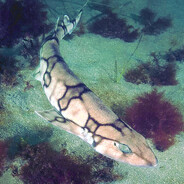
The chain catshark or chain dogfish (Scyliorhinus retifer) is a small, reticulated catshark that is biofluorescent. The species is common in the Northwest Atlantic, Gulf of Mexico, and Caribbean. It is harmless and rarely encountered by humans.

The chain catshark is found in the Northwest Atlantic, Gulf of Mexico and Caribbean, ranging from George's Bank in Massachusetts, to Nicaragua and Barbados. In the Mid-Atlantic Bight, the chain catshark is found along the outer continental shelf and upper slope. The shark occupies depths of 36 to 750 meters (118–2,461 ft); in the northern part of its range it is mainly found between 36 and 230 meters (118–755 ft) and in the southern areas generally deeper than 460 meters (1,510 ft). Due to the shark's depth distribution, it has been suggested that the shark does not perform large-scale migrations.

The catshark spends the daytime resting at the bottom, usually in contact with certain structures. It has been observed with large burrowing cerianthid anemone tubes and boulders. The bottom rubble is thought to be used as a camouflage with the shark's spotted surface. Adult sharks tend to prefer rough bottoms, creating a difficulty for trawl sampling, while the immature forms are found near smoother regions. The chain catshark has been known to feed on squid, bony fish, polychaetes and crustaceans. In aquaria, they are relatively motionless, spending the day resting on the bottom, but during the night and when fed they are very active.
The chain catshark or chain dogfish (Scyliorhinus retifer) is a small, reticulated catshark that is biofluorescent. The species is common in the Northwest Atlantic, Gulf of Mexico, and Caribbean. It is harmless and rarely encountered by humans.

The chain catshark is found in the Northwest Atlantic, Gulf of Mexico and Caribbean, ranging from George's Bank in Massachusetts, to Nicaragua and Barbados. In the Mid-Atlantic Bight, the chain catshark is found along the outer continental shelf and upper slope. The shark occupies depths of 36 to 750 meters (118–2,461 ft); in the northern part of its range it is mainly found between 36 and 230 meters (118–755 ft) and in the southern areas generally deeper than 460 meters (1,510 ft). Due to the shark's depth distribution, it has been suggested that the shark does not perform large-scale migrations.

The catshark spends the daytime resting at the bottom, usually in contact with certain structures. It has been observed with large burrowing cerianthid anemone tubes and boulders. The bottom rubble is thought to be used as a camouflage with the shark's spotted surface. Adult sharks tend to prefer rough bottoms, creating a difficulty for trawl sampling, while the immature forms are found near smoother regions. The chain catshark has been known to feed on squid, bony fish, polychaetes and crustaceans. In aquaria, they are relatively motionless, spending the day resting on the bottom, but during the night and when fed they are very active.
Favorite Game
Favorite Game
514
Hours played
83
Achievements
Review Showcase
Recent Activity
8.8 hrs on record
last played on 5 Feb
135 hrs on record
last played on 24 Jan
12.5 hrs on record
last played on 18 Jan