



Install Steam
login
|
language
简体中文 (Simplified Chinese)
繁體中文 (Traditional Chinese)
日本語 (Japanese)
한국어 (Korean)
ไทย (Thai)
Български (Bulgarian)
Čeština (Czech)
Dansk (Danish)
Deutsch (German)
Español - España (Spanish - Spain)
Español - Latinoamérica (Spanish - Latin America)
Ελληνικά (Greek)
Français (French)
Italiano (Italian)
Bahasa Indonesia (Indonesian)
Magyar (Hungarian)
Nederlands (Dutch)
Norsk (Norwegian)
Polski (Polish)
Português (Portuguese - Portugal)
Português - Brasil (Portuguese - Brazil)
Română (Romanian)
Русский (Russian)
Suomi (Finnish)
Svenska (Swedish)
Türkçe (Turkish)
Tiếng Việt (Vietnamese)
Українська (Ukrainian)
Report a translation problem


 Shield support was added to Spring in 2005 by SJ, back when the engine was the experimental playground, as Lua scripting was yet to be added. Not to be outdone by the future wackiness of Complete Annihilation, these shields repelled projectiles, with the Zero-K hard-shell version only being added later. Repulsion shields were taken up by the TA-derived mods, primarily as a defence against late-game Big Bertha spam, and 20 years later this is still their role in BAR. But Complete Annihilation, and later Zero-K, was very much about pushing mechanics as far as they can go, and damage mitigation opens up too many possibilities to be left to languish in a corner of the game. Besides, the narrow late-game linchpin role was superbly filled by nuke and antinuke, so we set out to integrate shields into the rest of the game. We succeeded, but had to drop repulsion as a result.
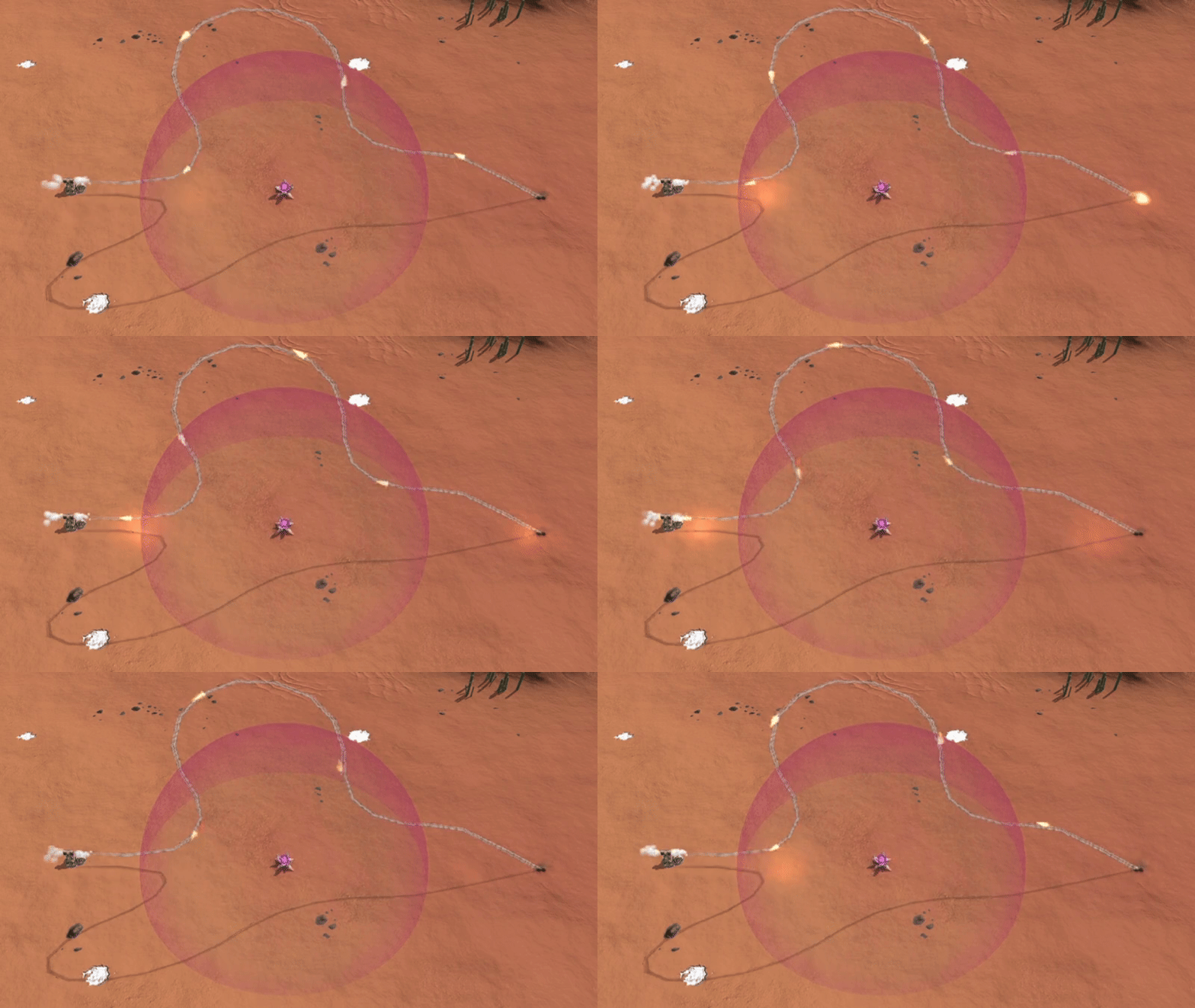 The engine supports repulsion for non-plasma weapons, but the behaviour is inconsistent. Lasers bounce right off while rockets and missiles are turned away using their usual turn radius. Homing missiles even resume homing after they leave a shield, which looks a bit ridiculous and can make shields a liability. But the more general issue is that of cost: repulsion shields push projectiles away over time, which drains shield charge for as long as the projectile is within the shield. This is cool in that it lets an overwhelmed shield fail gradually, but it plays havoc with any attempt to balance drain rates. The speed of the projectile matters quite a bit, as does the angle at which it hits the shield, since glancing blows take less force to deflect. Particularly fast projectiles, such as riot cannons or tactical missiles, can penetrate quite deep into the shield before being significantly deflected. The charge drain of lasers was sensible, since they are reflected instantaneously, but attackers could still line up shots to drain charge from multiple shields at once.
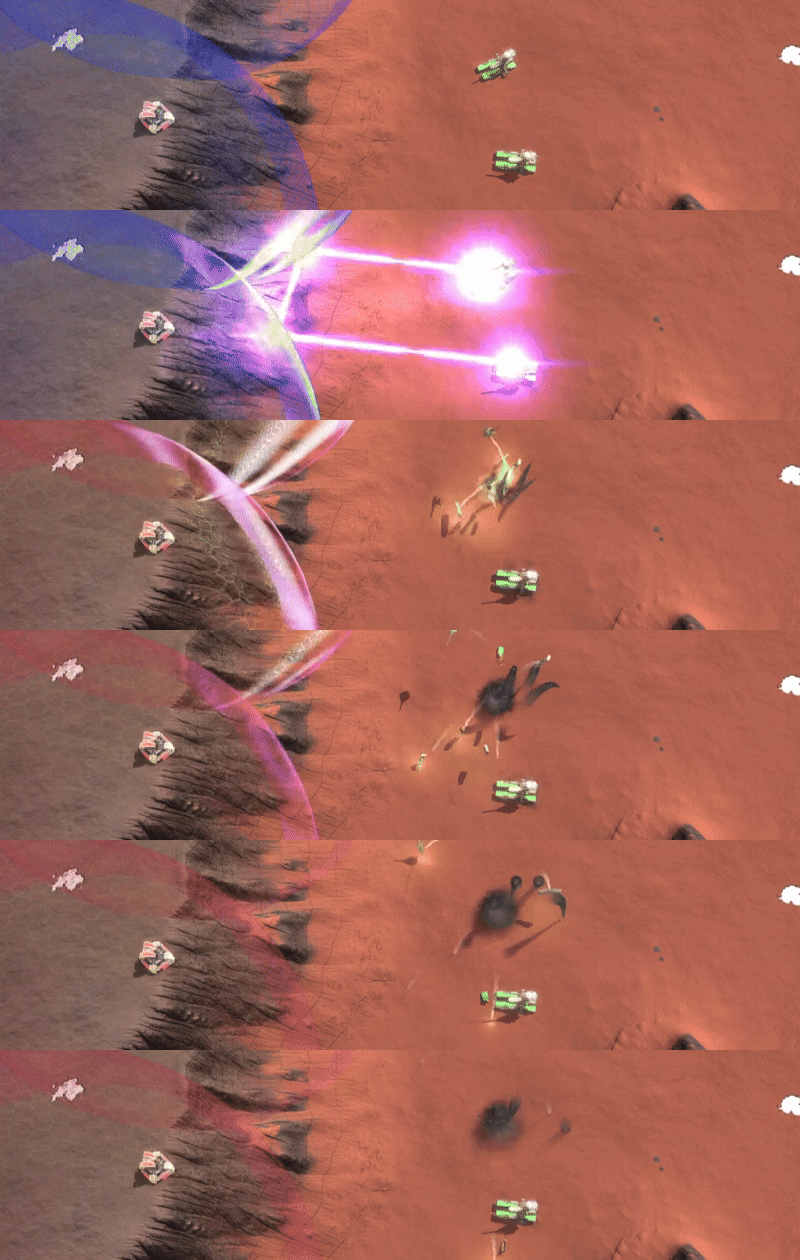 In the end, the fun physics had to be put aside, and shields became hard shells that block enemy projectiles. The projectiles are blocked by detonating them mid-air, and doing so costs shield charge equal to the damage of the projectile. If a shield has insufficient charge at the moment of impact, then the projectile is allowed through. Shields regenerate charge over time, and share charge around to try to equalise nearby shields. This is a fairly simple system, but there is enough to it to dial in some satisfying interactions.
 Another notable part of the shield mechanics is that the interception threshold is per-projectile. So a shield at 599 charge lets through a 600 damage projectile, but would block half the damage of two shots that deal 300 damage each. Bursty units are balanced around this fact, with an extreme example being the 3000 damage Lance that deals damage in chunks of 150 over the course of a second. Phantom, with a single 1500-damage bullet, is generally better against shields for this reason. We have even used burst to buff units against shields, such as when the double-barrel shot of the Firewalker was split into ten projectiles, each with reduced AoE and more total direct damage. The interaction of burst damage and shields is one of the better kinds of emergent behaviour: one that players could reasonably puzzle out intuitively, rather than requiring the kind of deep dive that would be required to figure out how to optimally drain a repulsion shield.
 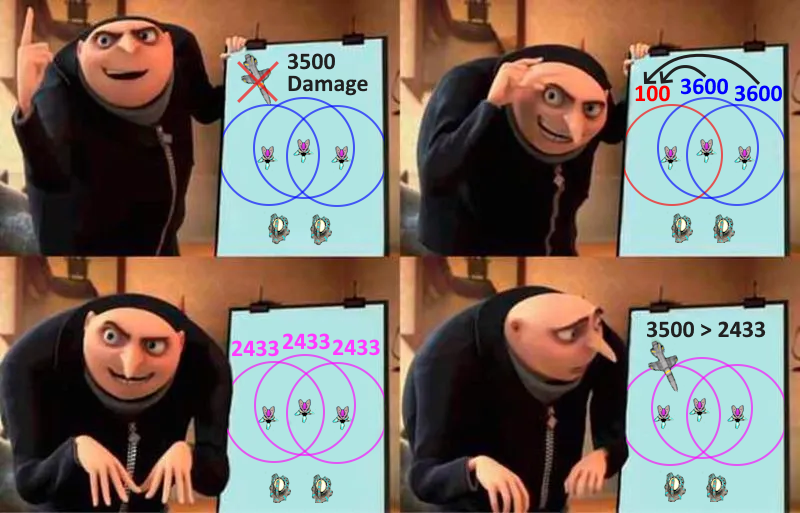 Shields would rather not be exploitable by tacnukes, but as we saw 25 posts ago, shield link is not optional. The downside of shield link gives shields space to be powerful in small numbers without becoming that much more powerful when spammed. This is the sweet spot we aim for across Zero-K as it encourages people to use a mix of tools, and it is especially important for mechanics that can slow down the game by preventing damage. The goal is to see a bit of shielding in many battles, rather than a lot in a few. This goes all the way back to the decision to make mobile shields and cloakers available to all factories by being available as a morph from their static versions.
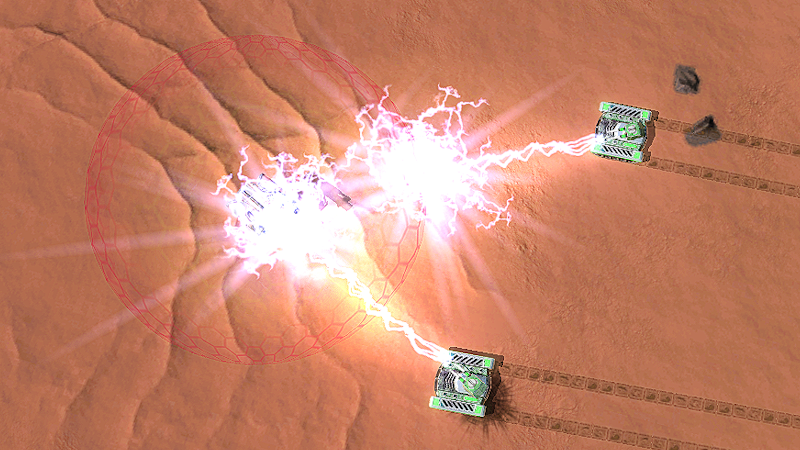 The last issue for today concerns status effects. Weapons should generally interact with shields, and thematically it would be weird for a lightning bolt to ignore shields or to be harmlessly dissipated. But letting shields take EMP, disarm or slow damage as if they were fully independent units would be too complicated. So to keep things simple, status effects deal damage to shield charge, just like ordinary damage, with caveats. The damage numbers of status effects are quite a bit higher than those of ordinary damage, since status effect damage has to hit health thresholds to take effect. Their raw damage would completely annihilate shields, so status effects only deal a third of their damage to shields. This is one of the rare instances of damage multipliers in Zero-K, and it is still enough damage to make lightning and slow damage some of the most effective ways to drain a shield.



 Award
Award 2
2


 Introduction to Unit Classes and Factories


 Introduction to Basic Economy


 Types of units for the basic factories (Cloak/Shield/Rover)
 A few neato things I discovered




 Askeri Sınıf Rehberi



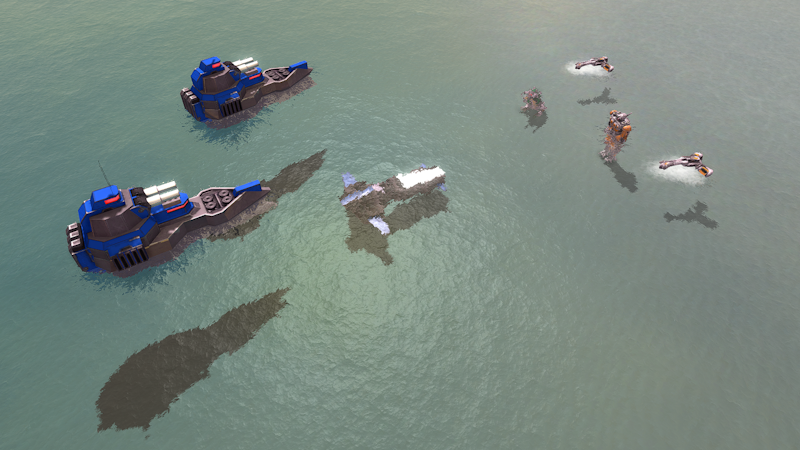 On land, all units (which are not flying, jumping or thrown) are standing on the ground. That ground might be flat, precipitous or anything in between. In water, on the other hand, there are four places a unit might plausibly be:
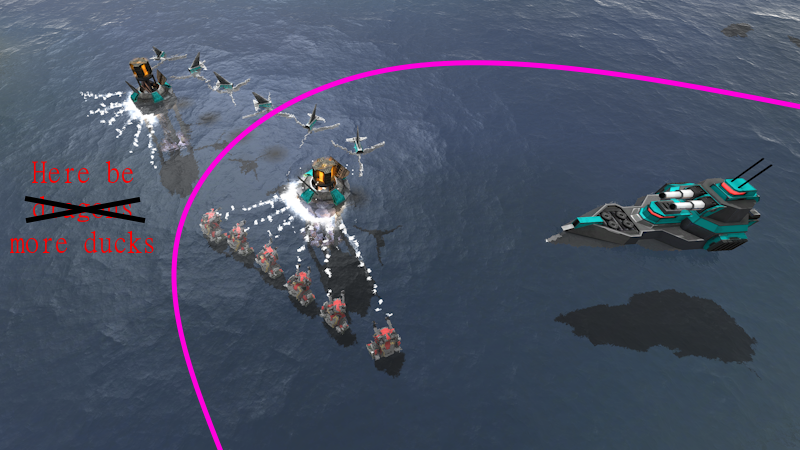 Verisimilitude demands that units under the water are more difficult to see than those on the surface. However, just like the ordinary fog-of-war mechanics deviate from `realistic’ line-of-sight for the purposes of gameplay, we simplify seeing underwater to a single mechanic, sonar. An enemy underwater unit is visible to us if and only if it is within the sonar radius of a friendly unit. To make things even simpler, in modern Zero-K all ‘sea units’ have sonar radius equal to their vision radius, while most other units do not (notably the Owl scout plane has limited sonar capability).
 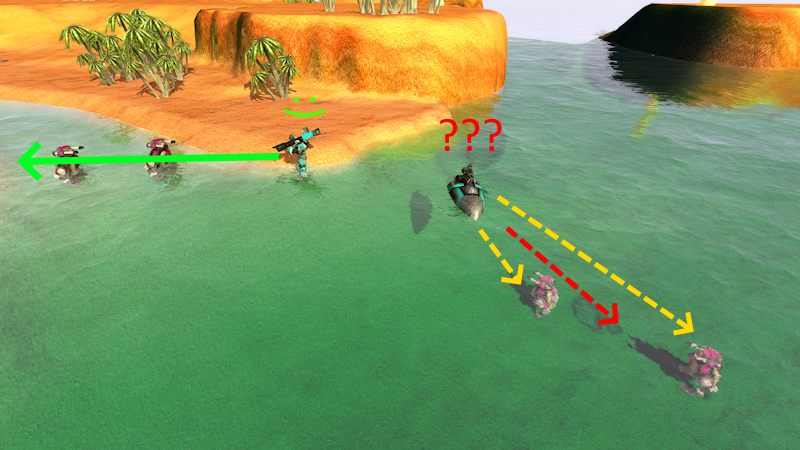 A second constraint on the weapons which are usable by and against underwater units is that the game mechanics must remain reasonable for a fairly wide range of water depths. Imagine, for example, a surface unit with an unguided torpedo with similar mechanics to the Ronin’s missile, firing at a group of Ducks on the sea floor. In shallow water the path of the torpedo traces a straight line lengthways through the Ducks, and is likely to hit one. In deep water the torpedo will instead have only a brief window where it is at an appropriate depth to hit the Ducks before it impacts the ground. This all sounds rather messy, so we have given all underwater-capable weapons tracking or other projectile properties which avoid this discrepancy.
 We conclude with a lightning round covering other interesting aspects of Zero-K’s sea design.


 Loading

