

Sid Meier's Civilization V

Sid Meier's Civilization V

Оцінок: 126
Zigzagzigal's Guide to Austria (BNW)
Автор: Zigzagzigal
Austria's ability to purchase City-States makes them excellent at suddenly creating footholds in new lands, but that's not all this Civ can do. This guide goes into plenty of detail about Austrian strategies, uniques and how to play against them.
   
Нагородити
До улюбленого
В улюблених
Прибрати
Introduction
Note: This guide assumes you have all game-altering DLC and expansion packs (all Civ packs, Wonders of the Ancient World, Gods & Kings and Brave New World)


History is always being written, and experienced, and created. Time is blind, and the people of a former power are no less important than those of the nation as a great power. The Austria you are to rule is a living land, one that has as bright a future as past. Settled in ancient times by Celtic peoples, the Roman Empire conquered the area around 2,200 years ago, but began to lose it four centuries later as Germanic tribes from the north pushed in. In the 8th century, Charlemagne, King of the Franks, would conquer the region, which would be formerly named and defined in the 9th century, and awarded to the Babenbergs. They would rule the marchia Orientalis - the Eastern March - until their line died out in the 13th century. They would be followed by Austria's most famous ruling family - the Habsburgs. The Habsburgs would gain vast, diverse lands for Austria and would successfully face off against the Ottomans in the 16th to 17th centuries. But with the rise of Prussia in the 18th century, a problem begun which would define Austria's future for 250 years - should these Germanic powers unify into a dominant European empire, or should they remain separate?

Austria and Prussia co-operated in the partitioning of Poland and the Napoleonic Wars. After the latter, they and other German states entered into the German Confederation, but after they invaded Schleswig and Holstein (small duchies then owned by Denmark) and could not agree on its administration, Austria withdrew from the political union. The following year, (1867,) in face of growing nationalism in Hungary, a significant part of the Austrian empire, a compromise had to be reached, redefing the lands as the Austro-Hungarian empire. This compromise was not enough to stem the tide of nationalism, and when Austria-Hungary attempted to formally annex occupied Bosnia, a Yugoslav nationalist assassinated the heir to Austria-Hungary's throne - Archduke Franz Ferdinand. Austria responded by invading Serbia, but due to a complex web of alliances existing in Europe, they engulfed Europe in the First World War. The defeat of the Central Powers saw the partitioning of Austria-Hungary leaving a significantly smaller Austrian republic and multiple newly-independent states in its place. In the 1930s, economic collapse led to the rise of fascism, and eventually the annexation of Austria by Nazi Germany. Following the Second World War, Austria was partitioned into occupation zones by the victorious Allies, but unlike Germany, the division was not to last. Austria was then to persue a policy of neutrality, although to a lesser extent than neighbouring Switzerland, but now the Eastern March has a decision to make. Is Austria's future in neutrality, or in closer ties with western powers? Can you find Austria's place in this brave new world? Can you build a civilization that stands the test of time?


Before I go into depth with this guide, here's an explanation of some terminology I'll be using throughout for the sake of newer players.

Beelining - Focusing on obtaining a technology early by only researching technologies needed to research it and no others. For example, to beeline Bronze Working, you'd research Mining and Bronze Working and nothing else until Bronze Working was finished.
Finisher - The bonus for completing a Social Policy tree (e.g. Free Great Person for Liberty.)
GWAM - Great Writers, Artists and Musicians. These are the three types of Great People who can make Great Works, a major source of tourism for cultural Civs.
Meatshield - A unit that can soak up damage on behalf of another. Standard melee units are often good at this job.
Melee Units - Throughout this guide, "melee units" typically refers to all non-ranged military units - whether on the land or sea. "Standard melee units" refer to Warriors, Swordsmen, Longswordsmen, Spearmen, Pikemen, Landsknecht and replacement units for them.
Opener - The bonus for unlocking a Social Policy tree (e.g. +1 culture for every city for Liberty's opener)
Spotter - A unit which allows a ranged unit (usually a siege unit) a line of sight with its target. Typically, siege units have a higher maximum range than their sight radius, hence the need for spotters.
Tall empire - A low number of cities with a high population each. "Building tall" refers to making an empire a tall one.
UA - Unique Ability - The unique thing a Civilization has which doesn't need to be built.
UB - Unique Building - A replacement for a normal building that can only be built by one Civilization.
UU - Unique Unit - A replacement for a normal unit that can only be built by one Civilization or provided by militaristic City-States when allied.
Uniques - Collective name for Unique Abilities, Units, Buildings, Improvements and Great People
Wide empire - A high number of cities with a low population each. "Building wide" refers to making an empire a wide one.
At a glance (Part 1/2)
Start Bias

Austria has a hill start bias. This will be good for providing your capital with adequate production, as well as increasing your chance of starting near mountains (useful for extra science from Observatories.) Cities on hills have the advantage of having higher strength (hence making them harder to capture) while unlike every other Civ in the game, there's no downside to settling cities on hills as your UB replaces the Windmill and removes its flat land requirement.

Uniques

Austria's uniques take quite some time to get going. Their UB is the latest one in the game, arriving in the late renaissance and their UU comes in the early industrial era.

Unique Ability: Diplomatic Marriage

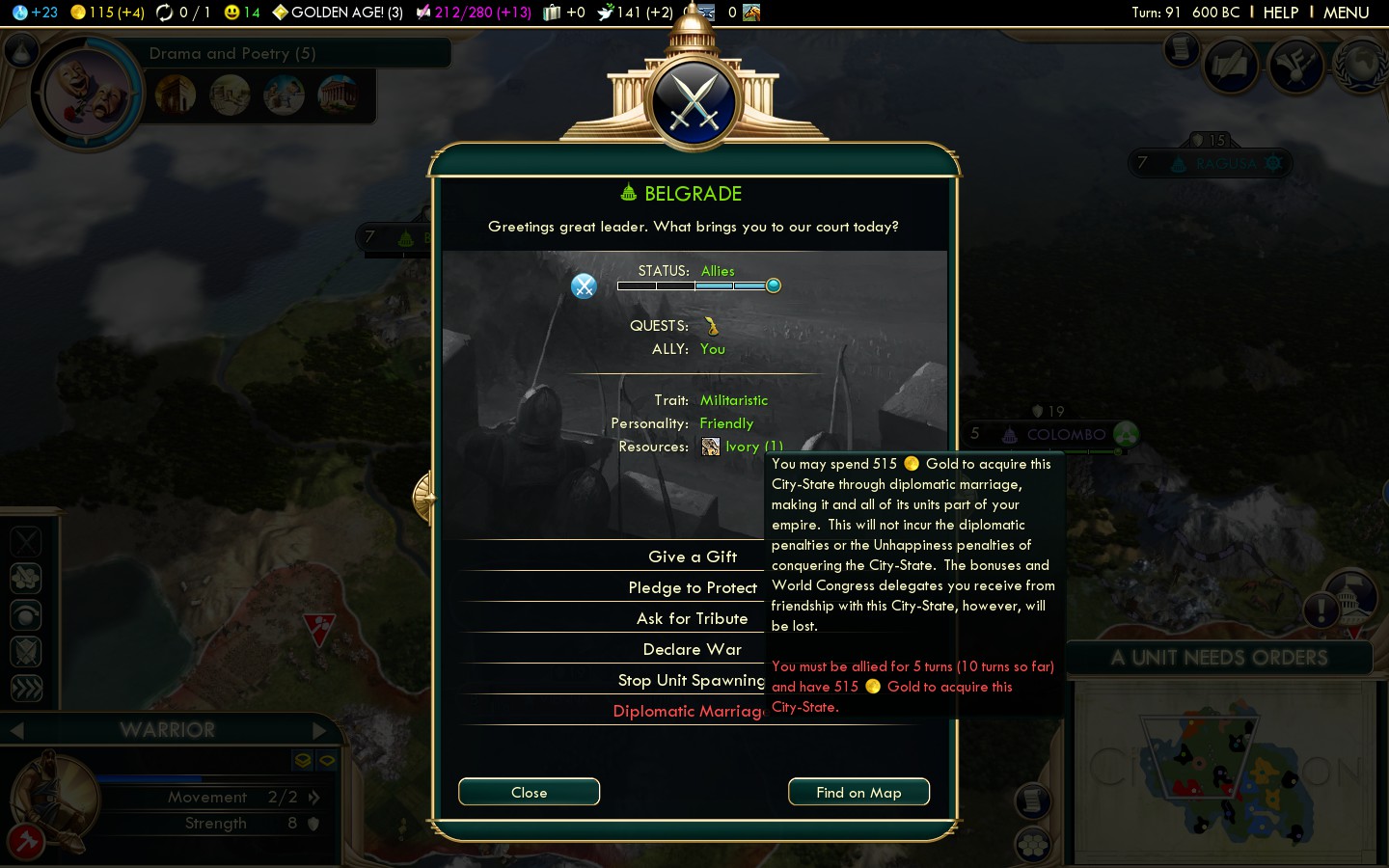
  • If a City-State is allied to you and has been for 5 consecutive turns, you may spend gold to annex or puppet it into your empire.
    • The turn you first allied with the City-States does not count as one of the 5 consecutive turns.
    • The cost of the City-State scales with the number of units they control (starting at 500 gold with no units in normal-speed games.) All the units controlled by the City-State (including ones outside their own lands) become under your control. If the City-State has more than one city, you will gain them all.
    • All buildings present in the City-State are retained on puppeting or annexation.
    • Annexed City-States do not count as occupied, and as such creates no more unhappiness than puppeting the city.
    • The annexed or puppeted City-State loses its original capital status, and hence is able to be razed by rivals and is unable to become a City-State once more. The number of delegates needed to win diplomatic victory is adjusted accordingly.
    • Annexing or puppeting a mercantile City-State destroys their unique luxuries.

Unique Unit: Hussar (Replaces the Cavalry)


A mounted melee unit

Technology
Obsoletion
Upgrades from
Upgrades to
Production cost
Purchase cost
Resource needed

Military Science
Industrial era
1st column
(10th column overall)

Combustion
Modern era
2nd column
(13th column overall)

Knight
(220Gold)*

Landship**
(260Gold)*
225Production*
740Gold*

1 Horse
*Assumes a normal speed game.
**Requires 1 Oil resource.

Strength
Ranged Strength
Moves
Range
Sight
Negative Attributes
Positive Attributes
34Strength
N/A
5Movement Points
N/A
3
  • No defensive terrain bonuses
  • 33% combat penalty when attacking cities
  • Can move after attacking
  • +50% flanking bonus

Positive one-off changes

  • 5 moves, up from 4 (+25%)
  • 3 sight, up from 2

Positive keep-on-upgrade changes

  • +50% flanking bonus (15% instead of 10% strength bonus for every friendly unit adjacent to the enemy your unit is fighting)
    • Does not affect the flanking bonus received by other units (such as an adjacent Rifleman)

Unique Building: Coffee House (Replaces the Windmill)


Technology
Building required
Required to build
Production cost
Purchase cost
City restriction
Maintenance

Economics
Renaissance era
2nd column
(9th column overall)
None
None
250Production*
1000Gold*
None
2Gold
*Assumes a normal speed game.

Base output
Output Multiplier
Specialist
Great Work slots
Other effects
2 Production
+5% Production
+25% Great People Points

1 Engineer
None
None

Negative changes

  • 10% production bonus for buildings removed

Positive changes

  • Can be built in any city, not just those on flat land
  • 5% production bonus
  • 25% Great Person Points bonus
At a glance (Part 2/2)
Victory Methods

Note these scores are a matter of personal opinion based on experiences with the Civilization. You may discover a way of utilising the Civ more effectively in unconventional ways.

Cultural: 7/10
Diplomatic: 3/10
Domination: 9/10
Scientific: 7/10

Austria can be effective at any victory route except for diplomacy, which their UA actively discourages (although allied City-States pre-annexation are good for World Congress delegates.) Their UB may come late but it's very useful at boosting Great Person generation, both good for cultural and scientific victories, while their UU favours heading into war. Their UA can work well for all three.

Similar Civs and uniques

Overall

Although the obvious parallel may be Venice due to the ability to buy out City-States, the two Civs actually play very differently. Venice generally should stop after buying out a small number of cities early on as it dilutes their chances at diplomatic victory, while Austria can make very good use of the UA late in the game for strategic purposes (and their lack of financial advantages means going after a diplomatic win isn't too effective.)

Instead, Austria's most alike Civ is Russia. The obvious connection is how they both have Cavalry UUs which are good at picking off vulnerable units, but there's also parallels in production bonuses (Russia for strategic resources, Austria for the ability to build their Windmill-replacing UB in any city) and the ability to acquire land (Austria's UA and Russia's Kreposts.) A key difference is that Austria's UB encourages building tall via the Great Person bonus, while Russia's UA and UB best suit building wide.

Same start bias

The other Civ with the hills start bias is the Inca. Austria's UB covers a weakness of hills (the no-Windmill restriction) while Incan Terrace Farms add a new strength to them.

Similar to the UA

Time to bring up Venice again. Both Venice's Merchants of Venice and Austria's UA allow you to acquire City-States without conquest. Venice has it a little easier on one hand as they don't need to ally the city first, but harder on the other hand due to having to generate a Great Person which shares a threshold with Great Engineers and Scientists. Plus Venice can only puppet the city, so they're more limited what they can do with it.

Similar to Hussars

Other uniques that replace Cavalry include Russia's Cossacks, Moroccan Berber Cavalry and Shoshone Comanche Riders.

Flanking bonuses can also be found in the Buffalo promotions from Zulu Ikandas and the Sneak Attack promotion that Indonesia's Kris Swordsman can potentially get.

Similar to Coffee Houses

The removed restriction of Coffee Houses mirrors that of Indonesian Candi, and both of which offer Great Person bonuses.

From a production perspective, Coffee Houses are similar to Germany's Hanse - they're both renaissance-era UBs offering production, and fill a similar niche.
Unique Ability: Diplomatic Marriage


Much alike Sweden, Austria combines building tall for specialists, City-State diplomacy and late-game warfare. Unlike Sweden, Austria uses City-State diplomacy with the intention of taking over City-States, rather than keeping them as allies.

Diplomatic Marriage allows you to annex or puppet City-States you've been allied with for 5 turns, not counting the turn you first allied them in. You'll gain all of their units, their buildings, and the City-State will now be treated as if you founded it - meaning there's no extra unhappiness penalty from annexing the city compared to puppeting it.

The early-game

Austria should start by building tall. Take the Tradition tree, and try to get the National College up early (by turn 100 on normal-speed games, but earlier is better.) This will give you the scientific edge to release a Hussar/Artillery army upon the world later in the game, but is also good for pursuing a cultural or scientific route to victory.

What about annexing City-States? Well, that's often difficult at this stage of the game. While destroying a couple of Barbarian encampments can secure you an alliance, getting over 500 gold (in normal-speed games) for the marriage really isn't cheap. And even if you can afford it, wait until you have the National College up and running first. That will give the City-State time to develop, while also allowing you to annex the city without making the National College harder to build.

National College to Coffee Houses

Austria's midgame is where things begin to get interesting. Technology-wise, head towards Education once the National College is done, then head towards Economics. If you're playing culturally, a diversion for Acoustics is fine.

That doesn't sound so exciting, but it's this point in the game where your UA becomes rather useful. There's a bit more cash around, so you have some choice as to which City-States to take over, and you can take the Patronage Social Policy tree to make that even easier.


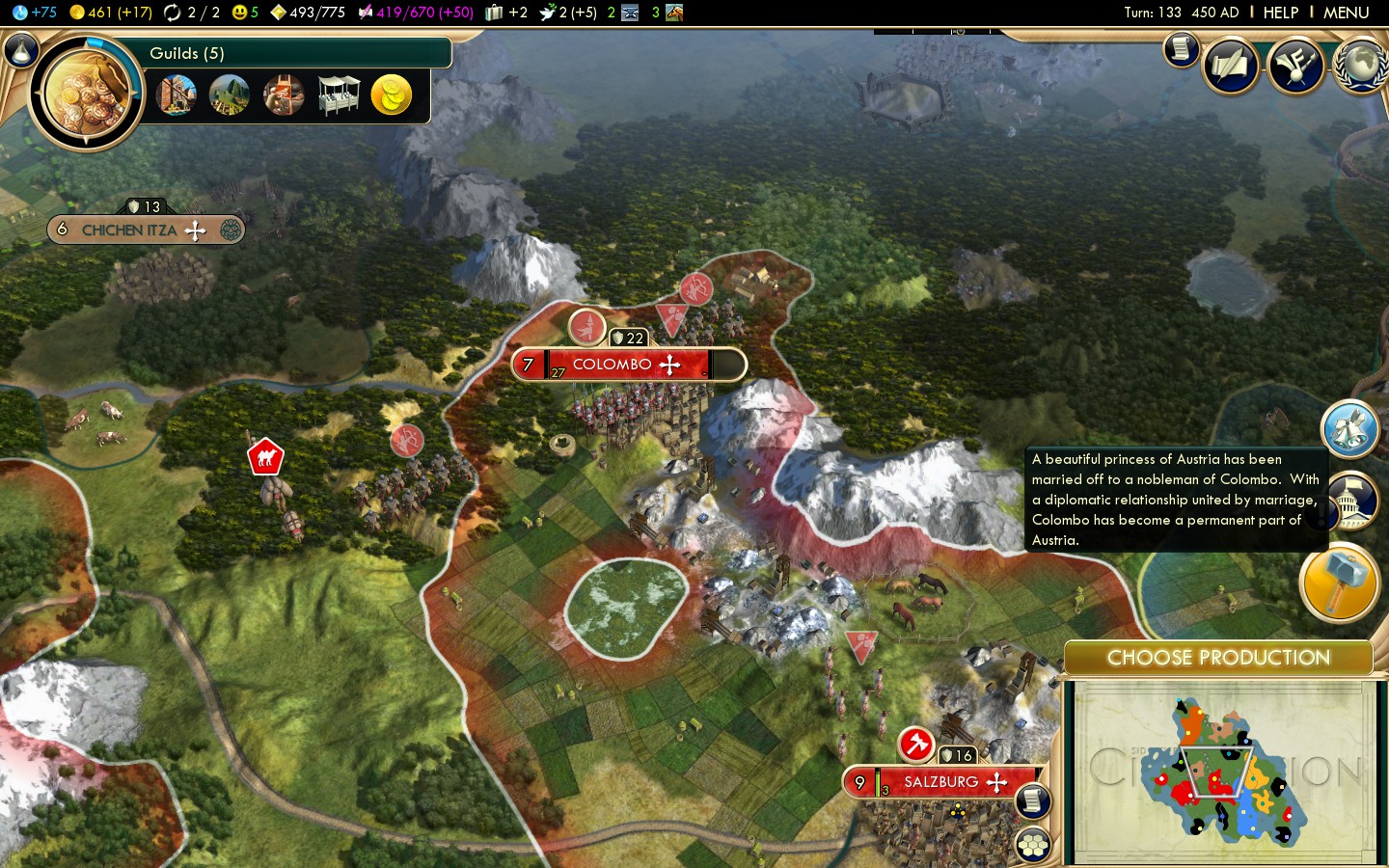
Above: For strategic reasons, I annexed this mercantile City-State, and all of its units.

If you're aiming for a domination victory, the decision to annex City-States or not rests on their strategic importance. City-States between you and a Civ you want to conquer later? City-States giving you a foothold in an area you otherwise wouldn't have? City-States that border you but are likely to be allied by enemies in the future? Those are all good targets for annexation. Don't go overboard with purchasing City-States - you need some happiness spare for conquests, after all.

For cultural and scientific players, the decision to annex City-States or not is more about the strength of the City-State itself. Tall City-States in resource-rich regions are the best targets for annexation. Having more cities will increase technology and Social Policy costs, so be careful which cities you choose, and again, don't go overboard.

Either way, you'll be getting a good city and its army without having to go to war. The practically-free army allows you to spend your production on other things instead - such as wonders. This is where building tall early on really pays off. The Leaning Tower of Pisa and Forbidden Palace will be particularly useful no matter your victory route.

Uniques and beyond

Out of your two uniques, you should get Coffee Houses first. Those will provide you with the production you need to build up an army. If you haven't already built it, it's rather effective to use Oxford University to grab Industrialism (as all it requires is Economics.) Factories will provide even more production, and building at least three lets you choose an ideology. If you lack coal, you can always annex a City-State which has it near them.

Now, it's onwards to Military Science. Now's a good time to build up a militaristic infrastructure while you soak up those prerequisite technologies. You'll need plenty of gold and happiness in particular. Once you have Military Science, build Military Academies (and maybe the Brandenburg Gate) before you start churning out Hussars, but don't start going to war yet! Head to Dynamite and build some Artillery to go with them. Now, you can start launching wars.

If you're after a scientific victory - typically the playstyle for isolationist builder Civs - it may seem somewhat odd going into war. You can do fine without it, consider the opportunity to take key rivals down a peg. It doesn't need to be a prolonged war that ruins your reputation and makes Research Agreements impossible.

For cultural players, wiping out a Civ with a high culture output certainly makes victory much easier, while Autocracy's Cult of Personality gives a massive tourism boost on Civs with a common enemy to you. Try getting two high-culture-output Civs to fight, and side with the one most likely to win. The more common enemies you have, the higher the tourism output.

But it's beyond the age of the Hussar, with the Radar technology, when your UA has its greatest potential...


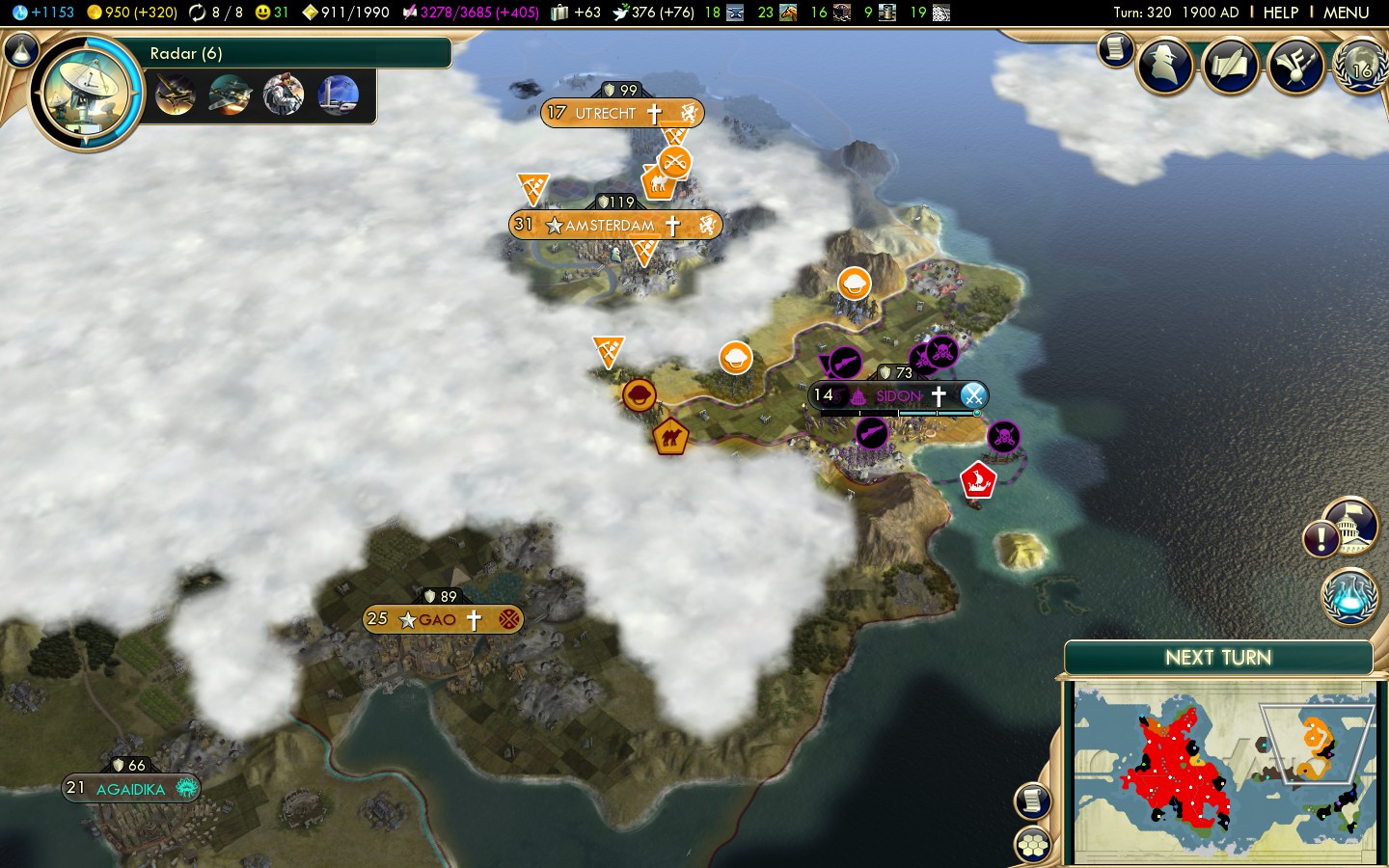
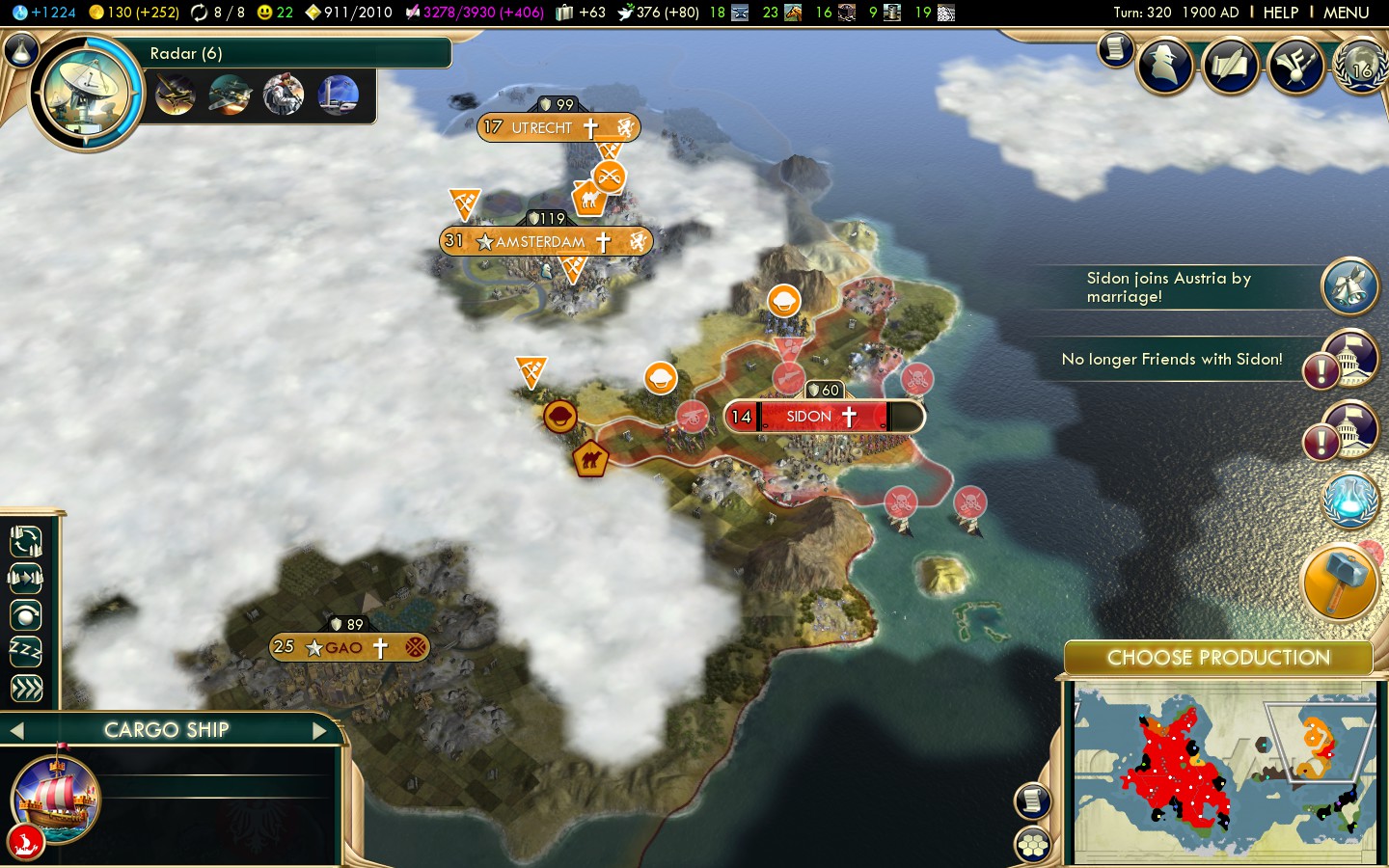
Above: Who needs a navy when I can annex a City-State on a new continent and airlift units in?

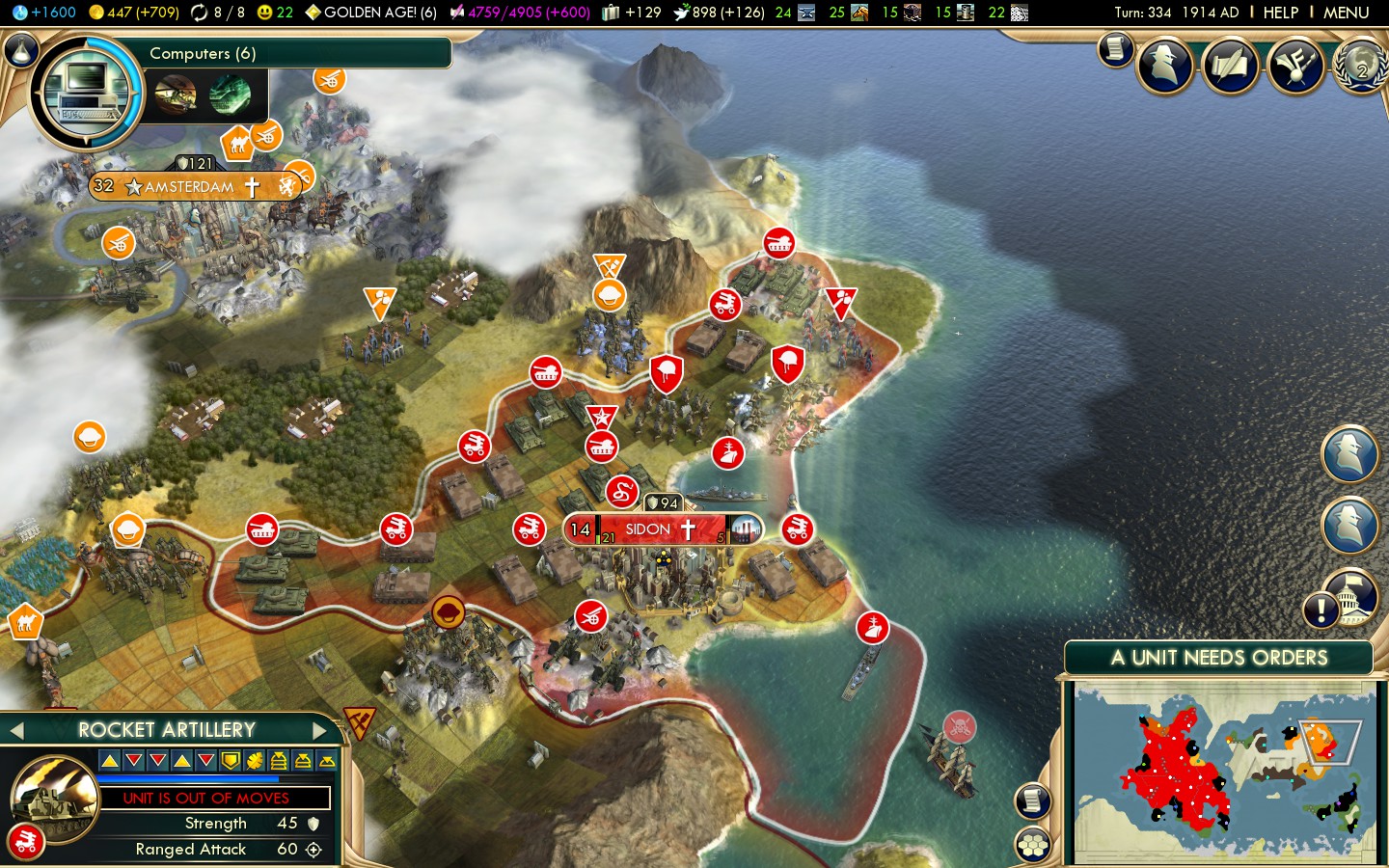
Aside from very small landmasses (or those occasional times a continent has no City-States in) Austria doesn't really need a navy, as getting an army into new lands is made easy with Airports. Upgraded former-Hussars combined with Artillery or Rocket Artillery can swarm into these new lands. Buying a couple of Fighters in that newly-annexed city will give you the line-of-sight and anti-air capabilities you'll need to complement that force.

If you encounter any conquered City-States while you're at war, liberate it. It'll reduce your warmonger penalties (meaning other Civs will hate you less) and after 5 turns you can peacefully annex it. Liberated City-States are automatically allied to you, so there's no need to go to any great difficulty to gain influence.

At the end of the game, Austria's victory routes diverge. The domination-minded players will carry on in their effort for world domination, the cultural players should use careful wars to maximise tourism output, and scientific players can quietly go ahead and build the spaceship.

Summary

  • Build tall in the early-game, and get the National College before you start annexing City-States
  • Warmongers should buy City-States for strategic reasons; other players should go for the best-developed City-States.
  • Don't go overboard with buying City-States; it's better to buy too few than too many.
  • Get Economics before Military Science to make use of Coffee Houses
  • Research Dynamite and build some Artillery before you launch a war
  • You can buy City-States on new continents and buy Airports in them to avoid having to build a navy.
Unique Building: Coffee House


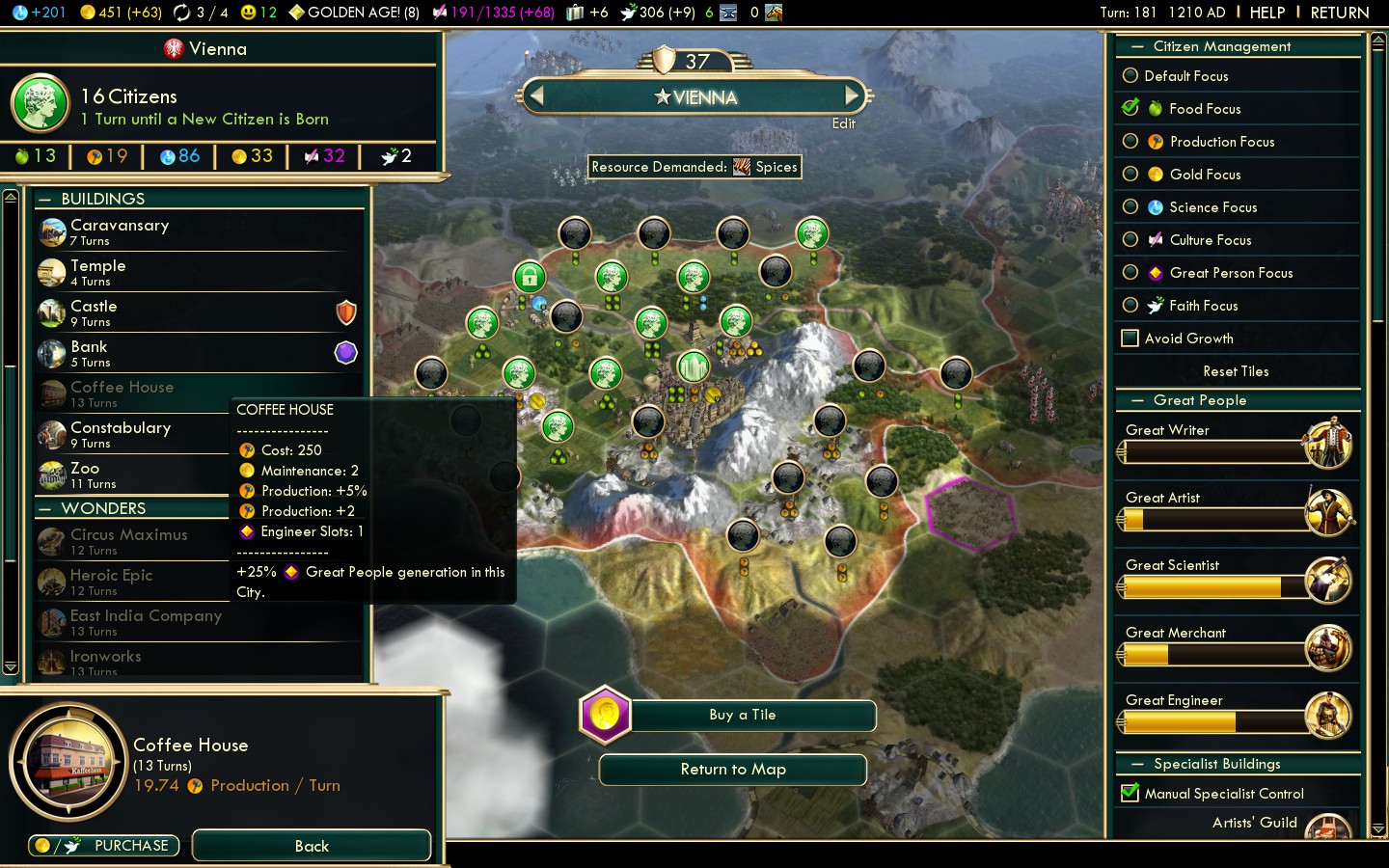
Coffee Houses offer much more than simply a 25% Great Person bonus. They may be the latest Unique Building in the game, but they're by no means the weakest.

Let's look through each of the Coffee House's features.

No terrain restriction

This is actually the key change here, as it means you can bring the production bonus Windmills offer to all of your cities, not just ones on flat land. Cities on hills have a higher strength, making them both harder to capture and able to deal more damage to would-be attackers. Furthermore, with no terrain restriction, it's much easier to find a riverside or lakeside spot so you can stack the Great Person bonus of Coffee Houses with the bonus from Gardens.

Changed production bonus

Instead of a 10% production bonus to buildings, Coffee Houses offer a 5% production bonus to everything. It's not a massive change, but it might help you build up your army a little faster.

With no terrain restriction and the changed production bonus, Coffee Houses now act as a second Workshop (though for over double the production cost and a halved production multiplier.) It's amazing what coffee can do.

25% Great Person bonus

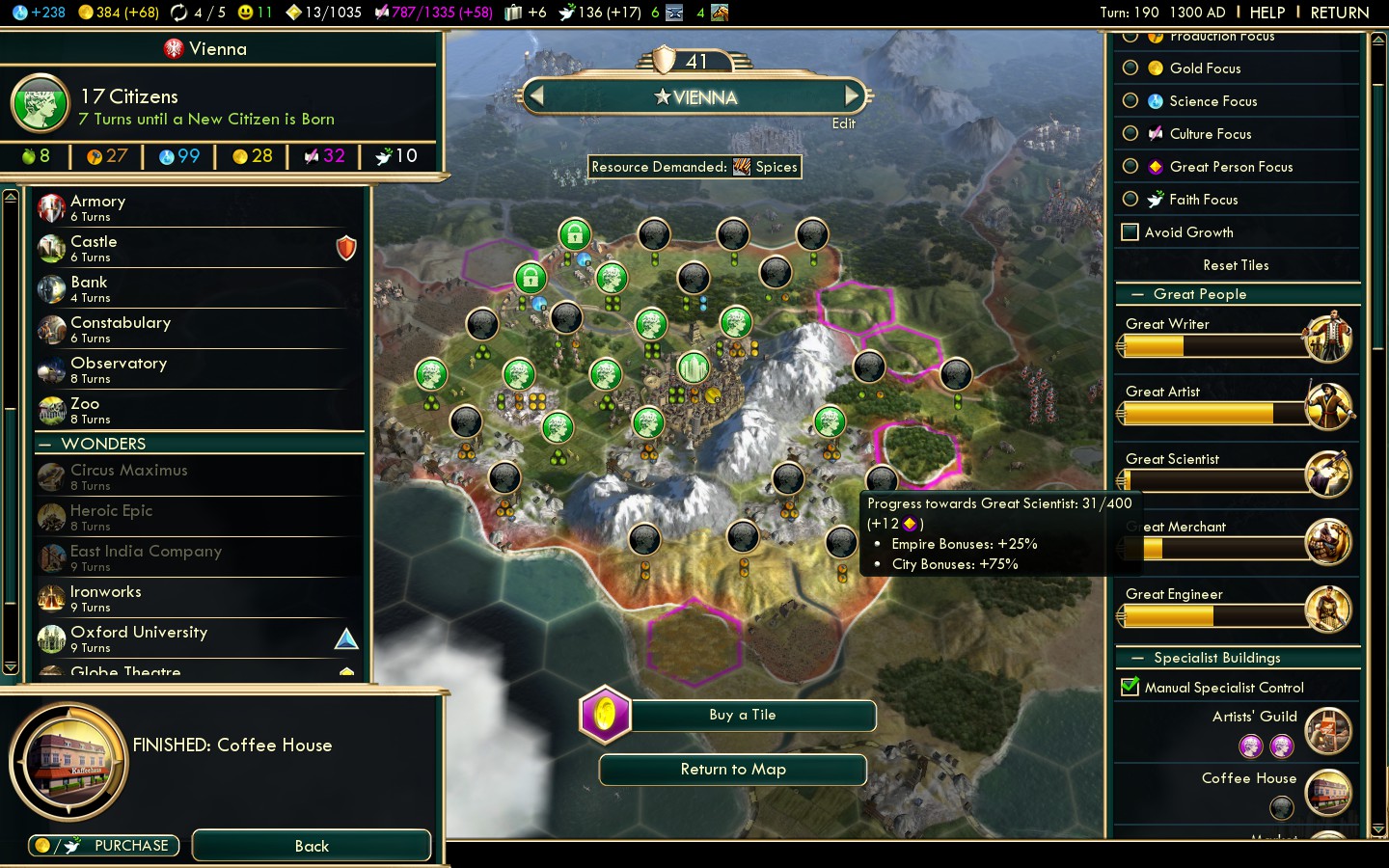
Along with acting as second Workshops, Coffee Houses also act as second Gardens. Build cities by a river or lake with a Garden and a Coffee House and that's a 50% Great Person bonus.


Above: This city has the effect of the Leaning Tower of Pisa and National Epic as well. While not being by a river or lake, it received a Garden from building the Hanging Gardens. Doubling your Great Person Points output before the industrial era ain't bad.

For warmongering or scientific players, get some scientist specialist slots filled. Don't just fill slots in your National Epic city - after all, Great Person Points are only reset to 0 for the city that generates the Great Person, so other cities may reach the new threshold faster than your National Epic city could.

For cultural players, focus on GWAM generation (although there's no harm in making some Great Engineers or Scientists; they'll raise the costs of each other when generated, but not the costs of GWAMs.) You'll need all the tourism you can get.

Conclusion

Coffee Houses are basically a second Workshop and a second Garden in the same building, giving you flexible bonuses which can be used for war, science or culture alike.
Unique Unit: Hussar
Not to be confused with Poland's Winged Hussar, a Lancer UU.


Much alike Russia's Cossacks, Hussars are excellent unit-killers but are weak against cities. Unlike Cossacks, however, Hussars have more than just extra damage potential.

Before we go into that, let's consider constructing the Hussar army. Once you've got your Military Academies up and running, you'll want to churn out lots. Usually, horses are so readily available by this point in the game that strategic resource requirements won't be a problem, but if they are, you can always ally and annex a City-State that has horses of their own. Of course, you can't use Hussars on their own - bring some Artillery with them, too.

Speed and Sight


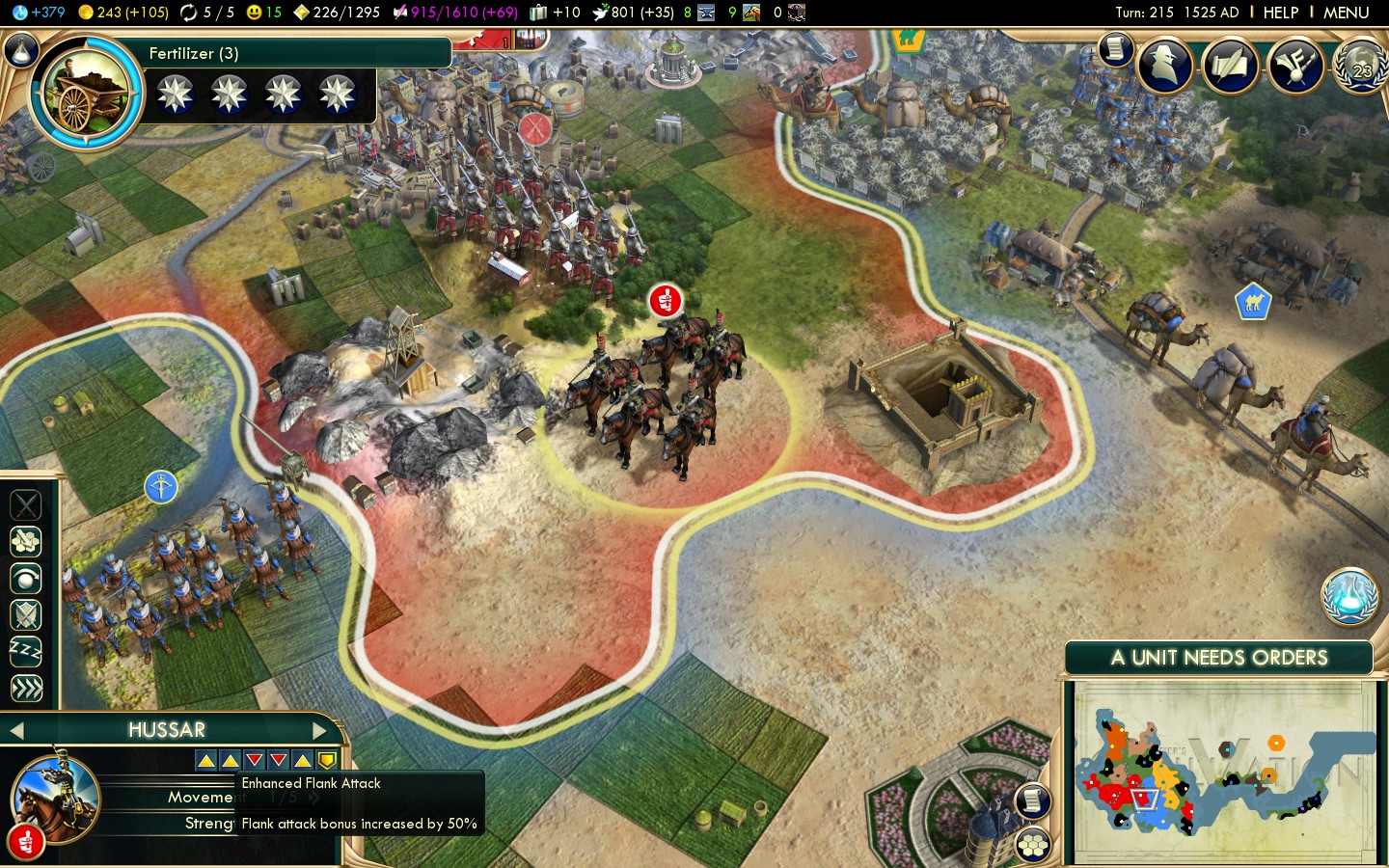
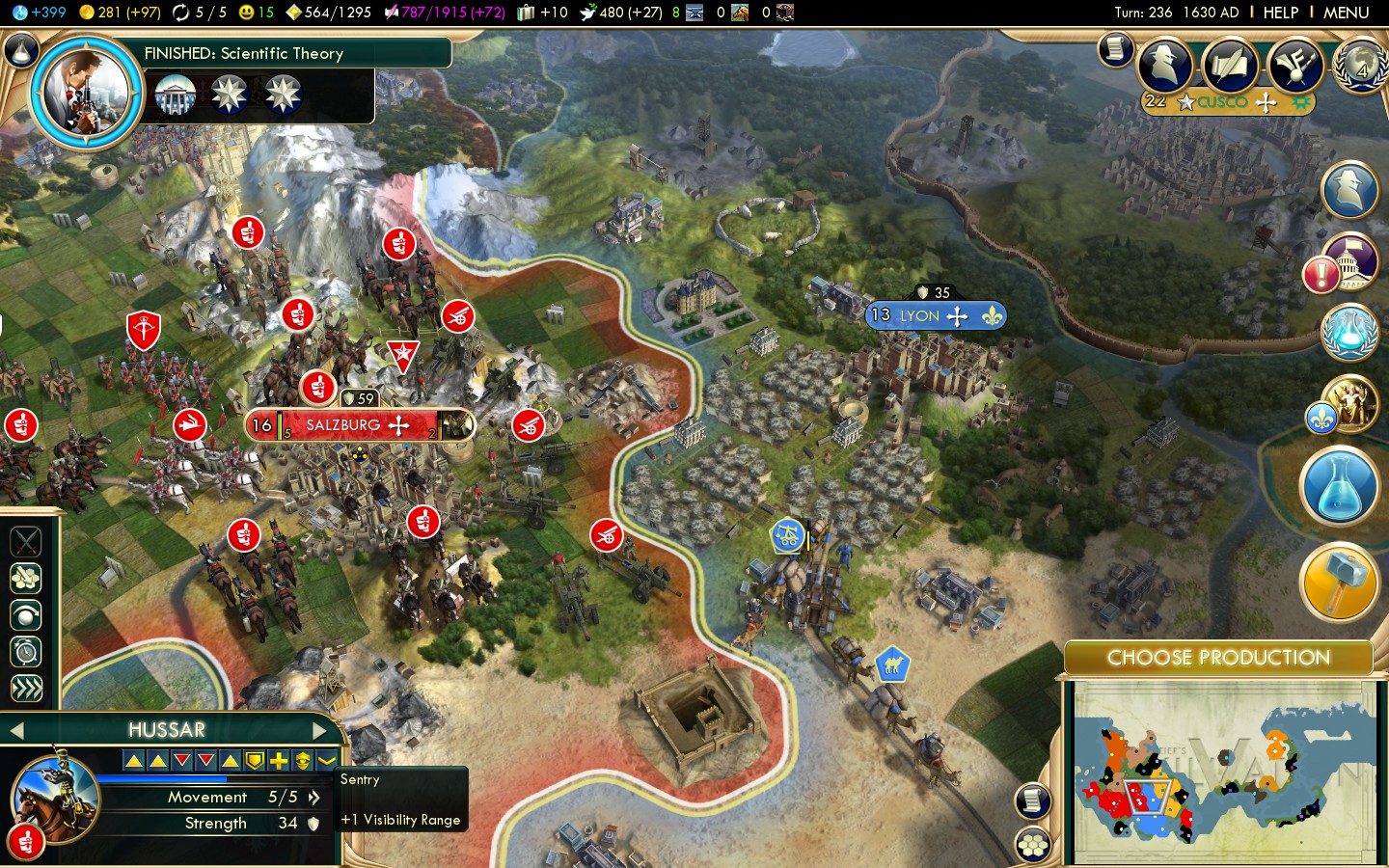
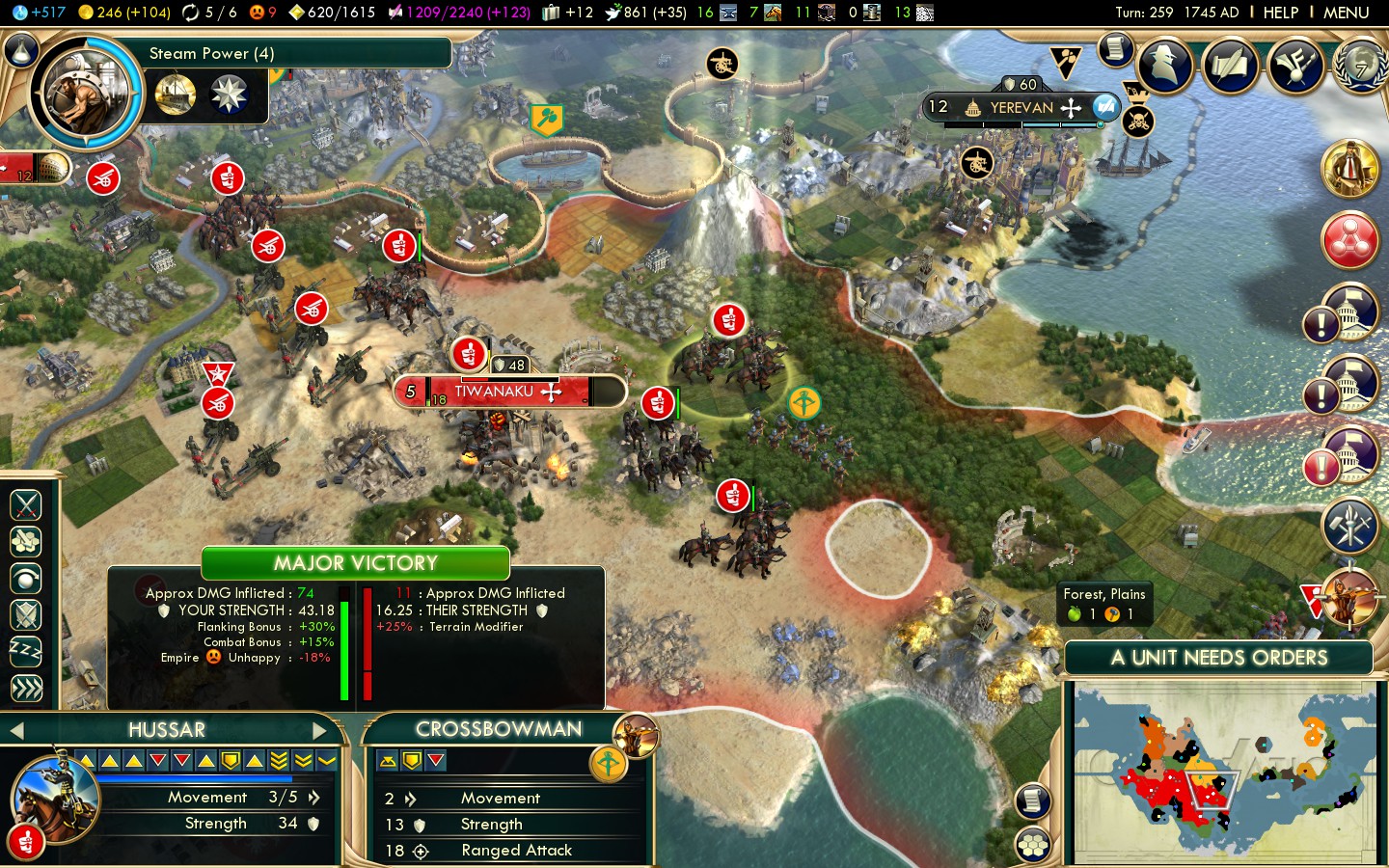
Above: Hussars make excellent spotters for Artillery, especially with the Sentry promotion. It's redundant to give all your Hussars Sentry - just give a couple of them the promotion.

The speed and sight Hussars have doesn't keep on upgrade, but it's handy while it lasts. Extra sight lets Hussars easily provide a line of sight for Artillery without putting them in danger, while extra movement lets them come in from a long distance away to get the last hit on a city and capture it. Extra movement also allows Hussars to outrun enemy Cavalry (aside from the Shoshone's Comanche Riders) and most importantly, get large flanking bonuses.

50% extra flanking bonus


Normally, melee units will receive a stacking 10% combat bonus for every friendly unit adjacent to the one they're attacking. This does not affect combat against cities, nor does it increase the damage of ranged units against the surrounded unit (a ranged unit adjacent to the enemy unit can contribute to the flanking bonus, but will not receive it). Because up to six units can surround another, the maximum combat bonus would be 50%. By increasing their respective flanking bonus by 50%, Hussars get a stacking 15% combat bonus, instead of the normal 10% - for a maximum of a 75% combat bonus against a unit completely surrounded.

The 50% flanking bonus increase (a bonus bonus?) doesn't affect other units. If a Rifleman and a Hussar were both adjacent to an enemy unit, the Rifleman would get a 10% combat bonus and the Hussar a 15% bonus.

To utilise flanking bonuses most effectively, move a few of your Hussars next to a unit before you start attacking it. Because Hussars can move after attacking, a Hussar can be supported by another unit, hit, kill and move to support that other unit's attack.

So, Hussars have strength in numbers, being able to do heavy damage while flanking, as well as having the more support-based roles of providing a line of sight for Artillery and getting the last hit on cities.

Special promotions kept on upgrade

  • 50% extra flanking bonus

One of the challenges when upgrading Hussars (aside from the cost) is the need for oil. Again, that's something that annexing City-States can cover, but be prepared to take a brief break from wars in order to secure oil supplies.

Hussars upgrade spectacularly. Here's why:


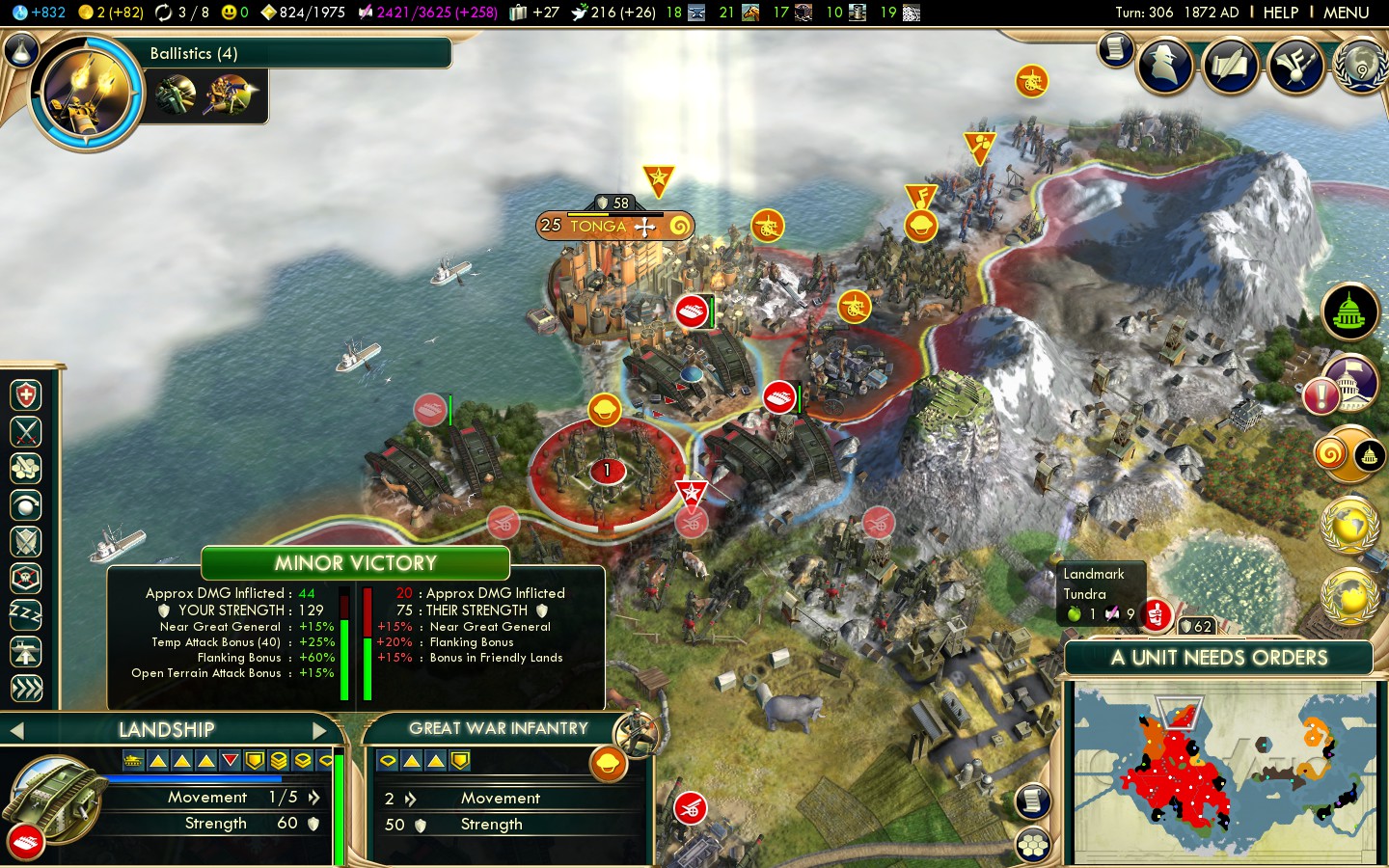
Above: Thanks to Autocracy's Lightning Warfare, I can slip this Landship through enemy lines (it ignores Zone of Control and gets a movement point bonus) and deal high damage (both thanks to flanking and the 15% attack bonus the tenet offers)

Of course, there's one little problem. The Autocracy ideology is the only one to lack a bonus to Great Person generation, so you lack that bit of synergy with your UB. Still, the loss of a couple of Great People is generally outweighed by the massive damage potential of super-easy flanking.

So long as you bring some anti-air with your former-Hussars, (Triplanes, Fighters, Jet Fighters, Anti-Air Guns or Mobile SAMs,) you can fight in pretty much the same way as before.
Social Policies: Pre-renaissance
Austria's early game is somewhat easier if you build tall and take Tradition, as it helps you prepare for Coffee Houses as well as having plenty of spare happiness for supporting conquests and purchased City-States. Afterwards, dip into Patronage a little - it'll make allying City-States (and hence purchasing them) easier. Once you enter the renaissance era, switch to Rationalism to keep your science up. Some spare policies can go into Commerce to ensure you have plenty of cash at hand for diplomatic marriages.

That path will suit both domination and scientific victories. If you want to take a cultural route, start in Aesthetics as soon as the Tradition tree is done.

Tradition

Opener

Fast border expansion is nice for ensuring your cities can reach good tiles sooner. Better tiles will often mean taller cities, and hence more specialists, more Great Person Points and more synergy with Coffee Houses.

Oligarchy

Not a spectacular policy, but you'll need this to get to the good stuff in Tradition. At least it'll save you a little cash in unit maintenance and help out a little if you're attacked.

Legalism

Free (in both the production and maintenance senses) culture buildings means you'll save time and have more cash ready for allying with and marrying City-States later.

Landed Elite

Growing your capital nice and tall will be great for maximising production, gold and specialist potential.

Monarchy

You won't need to worry too much about your capital's growth straining your empire's happiness, and growing your capital will now provide a helpful boost to gold output.

Aristocracy

There's a few nice wonders for Austria, and a production bonus to wonder building makes it a fair bit more likely you'll be able to pick them up. Alhambra and the Brandenburg Gate in the same city is a particularly potent combination.

Finisher

Now all your first four cities will grow faster. It's certainly a good idea to spread out tasks between your cities (Great Person generation, wonder-building, unit-building, etc.) in order to avoid overstretching your capital.

If you're aiming for a cultural victory, go to Aesthetics after this point. Otherwise, go into Patronage followed possibly by Commerce if you have spare policies before the renaissance.

Patronage

Opener

While slower influence decay usually won't mean the difference between you holding on to an alliance for 5 turns and not, it does make quite an impact if you're trying to gain influence in a City-State you already have some with.

Consulates

The most important policy in Patronage. A City-State alliance now takes a minimum of 40 influence, rather than 60, making alliances considerably cheaper to obtain.

Philanthropy

And if your money could stretch further than before thanks to Consulates, it can even more so with Philanthropy. Getting the cash for an alliance and a diplomatic marriage still isn't exactly cheap, but it will be an awful lot more affordable than before.

The later policies in Patronage focus on holding City-State alliances in the long-term, which Austria's UA discourages - switch to Rationalism instead, or Commerce if it isn't the renaissance yet.

Commerce

Opener

Need a little more cash to afford diplomatic marriages? You don't need to go very far into Commerce to find something that can help you out. Commerce's Opener adds a gold multiplier to your capital. As on standard map generators, your starting location will be near at least two luxuries, the gold bonus should be noticable.

Wagon Trains

Commerce's Opener is reasonable, but this is much better for increasing your gold output. Slicing the maintenance of roads and railroads in half, as well as improving the gold yield of land-based Trade Routes, Wagon Trains is worth picking up even later into the game.

Policies beyond Wagon Trains in Commerce are less focused on gold generation (aside from the Finisher, but it's not really worth taking three extra policies just for more trading post gold) so switch to Rationalism at this point.

Aesthetics (Cultural Austria favoured)

Opener

Coffee Houses are key to an Austrian cultural victory route, as they can help you generate GWAMs faster. With this policy, that's even more the case.

Cultural Centres

The cultural line of buildings takes quite some time to work through, so building them all faster will save a considerable amount of production.

Fine Arts

Excess happiness now adds to culture. It generally won't have an amazing output, but it's better than nothing.

Flourishing of the Arts

Greatly superior to Fine Arts, this policy gives a strong culture boost to cities containing wonders, and

Cultural Exchange

A considerable boost to three tourism modifiers. Diplomats are not affected, but shared Trade Routes, Open Borders and a shared religion is. Even without a shared religion (by far the hardest of the tourism modifiers) the three other methods listed here combine for a tourism bonus of over 100%.

Artistic Genius

One Great Artist isn't exactly the best thing a Social Policy can give you, but you'll need it for the strong Finisher, and it can help towards some of the trickier theming bonuses.

Finisher

Doubled theming bonuses means a strong boost to tourism output (and also culture, but it's tourism that matters the most.)
Social Policies: Rationalism
Rationalism

Opener

So long as happiness is positive, you'll receive a global 10% boost to science. You'll need that science boost for your military to remain competitive, so don't overstretch your happiness through excessive conquests.

Secularism

If you want to make the best use of Coffee Houses, you'll need a good number of specialists. Secularism adds science to them, making them even more effective.

Humanism

This goes nicely with Coffee Houses for a great boost to Great Scientist generation. Use them to build Academies prior to the modern era, then any beyond that should be used to rush technologies starting a few turns after you have a Research Lab infrastructure up and running.

Free Thought

While you might not make much use of the science bonus on trading posts, the University science bonus is something that certainly will be handy.

Sovereignty

Get some gold back from science buildings! More gold could mean more diplomatic marriages, and hence more angles to attack enemies by...

Scientific Revolution

Conquests will put other Civs off making Research Agreements with you, but one unviable policy is worth it for Rationalism's Finisher.

Finisher

Time this right and you can save a considerable amount of science. Be sure to choose a technology you haven't already started researching for maximum effect.
Ideology
If you intend to carry on using Hussars into late-game warfare by upgrading them into armoured units, Autocracy is a great ideology for Austria to pick - whether for conquest or an aggressive cultural victory. Alternatively, for a more peaceful route consider Order leading to a scientific victory. Freedom can also work for science and culture if you feel like keeping war to a minimum and focusing instead on your UB's Great Person bonus.

For each ideology, I'm assuming you're only taking the first "inverted pyramid" of each, so that's three level one policies, two from level two and one from level three.

Level One Tenets - Autocracy (Culture/Domination favoured)

Futurism (Cultural Austria favoured)

Hold off faith-purchasing GWAMs until now and you'll be rewarded with a sudden flood of tourism. This large tourism boost really helps to make up for the lack of a direct bonus to Great Person Points.

Industrial Espionage (Domination favoured)

Infrastructural technologies are at one side of the tech tree; most war-based technologies on the other. Spies allow you to focus on one while still keeping up with the other.

Fortified Borders

A decent, maintenance-free source of happiness. Goes particularly well with the Neuschwanstein wonder.

Elite Forces

Take Universal Healthcare instead if your happiness is low, as the effect of Elite Forces is fairly minor - it closes the gap in strength between wounded and non-wounded units by 25%.

Level Two Tenets - Autocracy (Culture/Domination favoured)

Lightning Warfare

The reasons for using this tenet have already been stated, but here it is again: easy flanking bonuses.

Militarism (Domination favoured)

This is a particularly strong source of happiness, though cultural players will probably find it less useful as they're less inclined to capture cities and construct XP buildings everywhere.

Total War (Cultural Austria favoured)

While those going for domination victories would also gain from Total War, for cultural players it's a chance to save on production - both for building units and for building Military Academies - allowing a greater focus on building wonders.

Level Three Tenet - Autocracy (Culture/Domination favoured)

Cult of Personality (Cultural Austria favoured)

The point of cultural warfare isn't to conquer all your foes, but to ally with Civs with high culture outputs against as many common enemies as you can manage. This is trickier to use than other level three cultural tenets, but it's potentially much stronger.

Clausewitz's Legacy (Domination favoured)

50 turns can be enough for world domination, or at least enough to put you in a position where you can't lose. Be sure to time this tenet right, and pick it up when you're ready.

Level One Tenets - Freedom (Culture/Science favoured)

Avant Garde

Builds upon the 25% Great Person point bonus of Coffee Houses.

Civil Society

Halving the food consumption of specialists means plenty of food freed up for use in growing your cities further. Taller cities are better for building wonders and spaceship parts with, after all.

Creative Expression (Cultural Austria favoured)

Increasing the culture output of Great Works really helps to chew through Social Policies and ideological tenets even faster than before.

Covert Action (Scientific Austria favoured)

Your spare Spies have to go somewhere, and rigging City-State elections is a good use of them. It's a way of ensuring you still have a presence at the World Congress without having to spend any cash.

Level Two Tenets - Freedom (Culture/Science favoured)

Universal Suffrage

Enjoy longer Golden Ages (and the production, gold and culture bonuses that brings) along with more happiness to help generate more Golden Ages.

New Deal

Landmarks and Academies alike will gain here, making this effective for both cultural and scientific players.

Level Three Tenet - Freedom (Culture/Science favoured)

Media Culture (Cultural Austria favoured)

The most reliable of the level-three-tenet tourism boosts. All you need is some Broadcast Towers.

Space Procurements (Scientific Austria favoured)

You've probably spent time building up a gold infrastructure for marrying City-States with. Now, you can use it for buying spaceship parts with instead. The Big Ben wonder or the Mercantilism Social Policy from the Commerce tree will reduce the expensive costs associated with those parts.

Level One Tenets - Order (Scientific Austria favoured)

Hero of the People

Builds upon the 25% Great Person point bonus of Coffee Houses. Use the Engineer specialist slots in Workshops, Coffee Houses and Factories to make Great Engineers, and save them for rushing spaceship parts with them.

Double Agents

Well, you don't want other Civs stealing your technologies, do you?

Socialist Realism

Okay, the remaining level one tenets don't really match up to the previous two, but happiness will still be useful against cultural Civs of a differing ideology.

Level Two Tenets - Order (Scientific Austria favoured)

Workers' Faculties

A science bonus on a building that's good anyway.

Five-Year Plan

A substantial boost to production, which will really be handy for building that spaceship.

Level Three Tenet - Order (Scientific Austria favoured)

Spaceflight Pioneers

Those Great Engineers you generated? You can use them to rush spaceship parts now. Science is nonetheless the main barrier on the way to victory, rather than the production of the spaceship parts themselves, so make your cities emphasise that.
Religion
A good religion can mean a great boost to growth or production, in turn having quite a significant impact throughout the game. This section lists a selection of the best beliefs for Austria, arranged by belief type. Highly-situational beliefs, including most faith Pantheons, are not listed here, although getting a faith-giving Pantheon is a good idea in order to increase your chances of getting a full religion.

City-States sharing your religion have a 25% slower influence decay rate if it's above the equilibrium point, and regain influence 50% faster if it's below the equilibrium point. That's useful for holding those alliances prior to marriages.

Pantheon

Sacred Waters

Riverside cities can build Gardens, which go nicely with your UB for a 50% Great Person Points bonus. Riverside cities also go well with this Pantheon for a happiness bonus.

Religious Settlements

While not a very strong Pantheon by any stretch, newly annexed or puppeted City-States are prone to having small borders - something this can help make up for.

Founder

Tithe

Tithe is the best of the gold-giving beliefs for tall empires, and the gold will be great for Research Agreements, unit maintenance and synergy with your UA.

Church Property

A backup if you can't manage Tithe.

Papal Primacy

Tricky to use, but helpful if you want to make future alliances (and hence marriages) with particular City-States easier.

Interfaith Dialogue (Scientific Austria favoured)

Essentially a pre-industrial way to convert faith to science. Target larger cities for more science.

Follower

Divine Inspiration

Turn that wonder-building into lots of faith! Makes spreading your religion nice and easy.

Religious Community

Grow your cities tall and you'll be rewarded with a production bonus of up to 15% - as much as Tradition's Aristocracy, but for everything, not just wonders.

Pagodas (Domination favoured)

If you're out a-conquering, you need the happiness to support that. Offering two points of local city happiness each, Pagodas are excellent in that respect.

Mosques (Domination favoured)

More faith but less happiness than Pagodas. Usually best as a backup (or complement, if you have enough faith.)

Peace Gardens

Gardens go well with Coffee Houses for a 50% Great Person points bonus, so let's make them even better with a happiness bonus.

Cathedrals (Cultural/Domination favoured)

For cultural players, this provides a source of rare pre-industrial Great Art slots. For the domination-inclined players, this is a backup to Pagodas and Mosques as a maintenance-free happiness source.

Religious Art (Cultural Austria favoured)

While not a particularly strong belief compared to some of the others on the whole, this does provide a decent amount of pre-Hotel culture and tourism which will accumulate over time. It's a very hard Follower belief for other Civs to exploit, so it's a nice choice if you intend to spread your religion abroad.

Enhancer

Religious Texts or Itinerant Preachers

Both of these make it easier to spread your religion without having to spend faith, freeing it up for other things such as faith-buying Great People in the late-game.

Reliquary

Coffee Houses increase the number of Great People you'll get, and hence the faith potential of this belief. It's the only Enhancer that offers faith, so if you're taking a faith-purchased building (e.g. Pagodas) it's certainly a strong choice.

Holy Order or Missionary Zeal

Get more religious spread for your faith.

Religious Unity

This only works for City-States you have at least friendly status in, but it's still useful, as City-States with your religion will see reduced influence decay - making it easier to ally with them.

Just War (Domination favoured)

It's tricky to make work, but Just War offers a 20% combat bonus near enemy cities with your religion - making it even easier to sweep through enemy units.
World Congress
Despite Austria's UA allowing you to annex allied City-States, it doesn't mean you should recklessly annex them all. Keep some around for the World Congress votes - there's some good stuff in here you'll want to pass (or, of course, other stuff you'll want to stop.)

Note "priority" in this section refers to how high you should prioritise your votes if it comes up, not how much you should prioritise putting them forward. Decisions not listed are usually clear in their context which way you should vote (e.g. an embargo of a luxury you own.)

Arts Funding

High priority
Vote yes if you're playing culturally
Vote no otherwise

Cultural Heritage Sites

Medium-High priority
Vote yes unless you lack wonders

Embargo City-States

Medium-High priority if you're aiming for domination
Low priority otherwise
Vote no

City-State trading offers a more secure route of trading than full Civs, if most of the world mistrusts you from warmongering. City-States can't unilaterally pillage your improvements or declare war on you, after all.

Historical Landmarks

High priority if you're playing culturally
Medium priority otherwise
Vote yes unless you lack Great Tile Improvements or Landmarks

International Games

High priority
Vote yes if you're playing culturally
Vote no otherwise

Even if you voted no, you should certainly work on it to deny rival cultural Civs the tourism bonus, and for grabbing the all-City-States influence boost. You might get a couple of new future cities City-State allies out of it.

International Space Station

Very High priority if you're playing scientifically
Low-Medium priority otherwise
Vote yes

Natural Heritage Sites

Low priority
Vote no unless you have a Natural Wonder of your own

Nuclear Non-Proliferation

High priority
Vote yes unless you've got lots of uranium or nuclear weapons and opponents don't

Scholars in Residence

Medium priority
Vote yes unless you're the leader technologically speaking

Sciences Funding

High priority
Vote yes if you're playing scientifically or aiming for domination
Vote no if you're playing culturally

Standing Army Tax

High priority
Vote no unless you're playing peacefully

Any form of domination victory or Autocracy-led cultural victory requires use of at least reasonably-large armies. You don't really want to pay extra for all those units.

World's Fair

Medium priority
Vote yes unless you're busy with building military units

With your strong coffee-driven production base, you should have a decent chance of seizing the cultural bonuses for yourself.
Wonders (Part 1/2)
Thanks to Coffee Houses, annexing fully-developed cities via the UA and the free armies from annexing City-States saving you from having to build units, Austria is rather good at building wonders. Here's a selection of the best, arranged alphabetically in each era.

Ancient Era

Great Library
Theming bonus wonder - 2 Great Writing, different Civs and eras for theming bonus

This wonder's much too risky to build on the highest difficulties, but otherwise enjoy the game's earliest theming bonus wonder and a huge scientific advantage.

Mausoleum of Halicarnassus

Once the Coffee Houses start operating, churning out Great People, you'll get quite a bit of cash off this wonder. Then, you can use that to fund City-State alliances or marriages.

Stonehenge

Tall-building Civs are typically at a disadvantage when founding a religion. Stonehenge helps account for that.

Temple of Artemis

Gives a 10% food bonus (not a growth bonus as the tooltip suggests - it's much better than that.) This wonder's notably less commonly sought-after by computer opponents than most, and it's cheap, too.

Classical Era

Hanging Gardens (Tradition Only)

The only way you can get a Garden in a city away from fresh water (unless you're playing as Indonesia.) Also has a huge food bonus - great for developing a city ready to build future wonders.

Oracle

Perhaps a lower-priority wonder, but a free Social Policy is still something that's nice to have.

Parthenon (Cultural Austria favoured)

The earliest possible source of tourism. Not a lot, but it'll really accumulate through the game. Plus, the attached Great Work will probably be your only classical-era one, making it good for later theming bonuses.

Terracotta Army

If you managed to buy a City-State early on, you might have an eclectic mix of units. The Terracotta Army builds on that. Otherwise, this is a tricky wonder to make work, and considering you only really need two or three types of units once you start your late-game wars, it's probably not worth it.

Medieval Era

Alhambra (Domination/Autocracy Cultural favoured)

The Alhambra gives another promotion to Hussars (among other non-ranged land units.) Stack with the Brandenburg Gate (or Autocracy's Total War) and a Military Academy and you can get Hussars straight to March.

Angkor Wat

Newly-acquired City-States tend to have small borders relative to your other cities. Angkor Wat helps making filling those spaces in easier.

Machu Picchu

A little faith is on offer here, but it's really all about the city connection gold - useful for unit maintenance or Research Agreements.

Notre Dame (Domination favoured)

Another wonder offering a little faith, but with a more useful main benefit: 10 points of global happiness - typically enough to support a conquest or two.

Renaissance Era

Forbidden Palace (Patronage Only)

A brilliant wonder for Austria, your non-occupied cities will create 10% less unhappiness from population - in other words, every 10th citizen is unhappiness-free. But that's not all - the wonder gives you two free delegates, which essentially gives you control of the World Congress until the industrial era. Try making your religion a World Religion, then use those delegates to make your ideology the World Ideology later on. Alternatively, use those delegates to compensate for the fact you'll be marrying some of your allied City-States and will hence lose those delegates.

Globe Theatre (Cultural Austria favoured)
Theming bonus wonder - 2 Great Writing, same era and Civ for theming bonus

Great Writing slots get rather rare beyond this point, so it's a good idea to grab this wonder to lessen that problem. And for the theming bonus, of course.

Leaning Tower of Pisa

Another high-priority wonder for Austria - but the problem is, it's high-priority for many other Civs as well. Succeed and you get a free Great Person, and all your cities with Coffee Houses will have a 50% bonus to Great Person Points that no other Civ has.

Porcelain Tower (Rationalism Only)

With Rationalism's Scientific Revolution, Research Agreements will always make you more science than the other Civ. Plus, enjoy a free Great Scientist. Use them to plant an Academy near your National Epic city.

Sistine Chapel (Cultural Austria favoured)
Theming bonus wonder - 2 Great Art/Artifact, needs art of the same era and Civ for theming bonus

Any rival cultural Civs are going to have a hard time facing your high culture output, and you'll chew through Social Policies much faster. Plus, enjoy two uncommon pre-industrial Great Art slots.

Taj Mahal

Mostly a wonder for if you have some spare production. A free Golden Age and some happiness is nice, but hardly earth-shattering.

Uffizi (Aesthetics Only, Cultural Austria favoured)
Theming bonus wonder - 3 Great Art/Artifact, needs art of the same era and Civ for theming bonus

Similar to Broadway and the Globe Theatre, Uffizi is a straightforward theming-bonus-and-a-GWAM wonder which is useful if you're playing culturally and much less so otherwise.

Industrial Era

Big Ben (Commerce Only)

Late in the game, you'll be able to marry City-States on other continents, buy an Airport and some aircraft, airlift units in and have an invasion force ready in a couple of turns. For that to be effective, you'll need quite a bit of money. Big Ben will help cut those costs (at least, the Airport/Aircraft-buying bit)

Brandenburg Gate (Domination/Autocracy Culture favoured)

With a Military Academy, this brings new units to three promotions. With the Alhambra in the same city as well, that's four promotions, and enough to get to March or Blitz. Additionally, a free Great General is provided by this wonder - useful if you haven't been to war yet and need that 15% strength bonus once you are at war.
Wonders (Part 2/2)
Modern Era

Broadway (Cultural Austria favoured)
Theming bonus wonder - 3 Great Music, same era and Civ for theming bonus

Yep, another GWAM-and-their-theming-slots wonder. This theming bonus is particularly tricky - it's worth keeping a Great Musician around until the modern era to make the criteria easier to fulfill.

Cristo Redentor (Cultural Austria favoured)

The high culture value means a decent amount of tourism with a Hotel, Airport and/or National Visitor Centre, while cheaper Social Policies mean you can chew through them even faster.

Eiffel Tower (Cultural Austria favoured)

12 tourism is equal to 3 Great Works with a Hotel and Airport, or 2 with the National Visitor Centre as well, which isn't too bad. On top of that, there's also 5 points of global happiness on offer.

Kremlin (Order Only)

It's not about the armoured unit construction - it's about the free Social Policy. This is certainly the weakest of the three ideology wonders, but it's still more or less worth building.

Neuschwanstein (Domination/Autocracy Culture favoured)

Castles now become sources of gold, culture and maintenance-free happiness. Particularly good when combined with Autocracy's Fortified Borders.

Prora (Autocracy Only)

Domination-minded players will make more use of the happiness, but cultural players will get more of it. And the free Social Policy is good for everyone.

Statue of Liberty (Freedom Only)

A very mighty wonder, the production on every specialist offered by the Statue of Liberty is great for building the spaceship or wonders alike. You can also enjoy the free Social Policy, if the already-strong main effect wasn't enough.

Atomic Era

Great Firewall

For a scientific playstyle, this makes it much, much harder for other Civs to steal your technologies. For cultural players, it prevents other Civs from picking up the wonder and denying you the doubled tourism from the Internet technology. And for domination-minded Civs, it prevents other Civs from making it hard to steal technologies from them, and slows cultural Civs from draining your happiness through ideological pressure.

Pentagon (Domination favoured)

While end-game upgrade costs typically aren't that high, you can still save quite a bit of money out of this wonder.

Sydney Opera House (Cultural Austria favoured)
Theming bonus wonder - 2 Great Music, same Civ but different eras for theming bonus

The last of the theming bonus wonders. The theming bonus is easy, and so long as you have a half-decent coastal city, the rest shouldn't be too hard, either.

Information Era

CN Tower (Cultural/Domination favoured)

With the Forbidden Palace, this wonder can actually create happiness on top of all the population points. It'll make your entire empire more productive, and for the Freedom-using cultural players among us, it'll mean every city benefits from the Media Culture tenet.

Hubble Space Telescope (Scientific Austria favoured)

Build this before you start going into spaceship parts and building Spaceship Factories, and you'll make the last few turns that little bit faster.
Pitfalls to Avoid
Like any Civ, Austria has misconceptions surrounding them, and common mistakes made by players. Here's a list of some of them.

Muddled strategies

Austria can pull effectively towards culture, domination and science, but try to do all three at once and you'll end up at a disadvantage. If you're not sure which route to take, start by playing scientifically and then choose whatever route seems the most viable or fun later in the game.

Excessive early expansion

The Coffee House UB encourages tall cities with lots of specialists. Building lots of cities early on runs counter to that. While it may be true that building wide helps ensure you can get more strategic resources, Austria can simply annex City-States which have the resource rather than building lots of cities and hoping for the best.

Marrying the wrong City-States

If you're aiming for a domination victory, it's all about strategic locations. Otherwise, focus on the area of the City-State itself.

Excessive marrying of City-States

There's only so much happiness to go around. Excessive use of your UA will lead to lots of unhappiness from the number of cities and population. Too much, and your enemies will exploit your weakness and likely invade.

Assuming the Hussar flanking bonus affects other units

Ignoring Zulu units, only Hussars or upgraded former-Hussars get a stacking 15% combat bonus per friendly unit adjacent to the enemy they're attacking. Other units get a stacking 10% bonus.

Divorce: The Counter-Strategies
Austria is like a cross between Sweden and Venice - a tall-building Civ with Great Person bonuses which can peacefully annex City-States - but has the same weakness as both of them - the early-game.

Playing against Diplomatic Marriage

First things first, the obvious - Austria can only marry a City-State they've allied for five turns. If you're allied with that City-State, or can take it out of their hands by allying with it yourself, they won't be able to puppet or annex it.

If Austria is allied with a City-State, and you can't possibly get an alliance with it, then's a good time to start bullying it for money or Workers. It doesn't matter if your influence crashes with a City-State that's just going to be annexed anyway. If Austria's pledged to protect the City-State, either their relations with you will worsen or they'll lose influence with it.

A more extreme option is to invade the City-State. Even if you don't conquer it, you can still make things harder for Austria by killing off its units (so Austria doesn't get them for themselves when the city's annexed.) True, killing units makes the city cheaper for Austria to annex, but not massively so. Don't be excessive with declaring war on City-States, or your influence resting point with them will drop, and your influence decay will increase.

If Austria does manage to annex a City-State, keep in mind it's impossible to turn it back into one, but on the other hand, it's no longer considered an original capital and hence can be razed if captured. Furthermore, the number of delegates needed for diplomatic victory will be lowered to compensate for the loss of a City-State. This can be quite troublesome if a strong diplomatic Civ is in the game, and Austria's picking off the City-States they're not allied with - it gives the diplomatic Civ a higher share of the potential delegates.

Later in the game, Austria's ability to settle new bases in other continents by buying City-States there may mean they neglect their navy. Build one of your own and you can really cause trouble for their coastal cities.

Playing against Hussars

Hussars thrive on flanking bonuses, but if they can't manage that, all they have left is a slight speed and sight advantage. Never leave units easily surrounded when Hussars or upgraded former-Hussars are around (well, you shouldn't do that anyway, but it's particularly true for Austria.)

As mounted units, Hussars are weak in defence, and if poorly positioned, they won't benefit from flanking bonuses when defending. Build some Lancers to help deal with them and back them with a Barracks so you can get the Formation II promotion for them, making them even stronger versus Hussars.

Playing against Coffee Houses

Like any UB, you can't easily play against Coffee Houses, but consider this: the Coffee House's bonus to Great Person points encourages use in conjunction with a river or lake for Gardens, but if you settle those freshwater spots first, they'll lose that Great Person potential. Additionally, Coffee Houses are placed on the tech tree a bit away from the military technologies of the era making Austria fairly vulnerable to attack during this time.

Strategy by Style

Early-game Aggressors

Austria's uniques typically don't get going until the mid-game, so they won't pose a challenge to take over.

Mid-game Warmongers

Watch out for any City-States Austria has allied in case they annex them and use them as forward bases against you. Otherwise, Austria isn't too much of a threat pre-Hussars.

Late-game Warmongers

Build a good navy to counteract Austria's probable lack of a strong one. In the industrial era, make use of promoted Lancers (or just promoted Riflemen or Cavalry of your own) to deal with Hussars; later than that air units will be effective against former-Hussars.

Cultural Players

Getting the Leaning Tower of Pisa means Austria's Great Person generation won't exceed yours, making it harder for them to achieve a cultural victory. Diplomatic marriages can mean Austria has lots of cities spread throughout the world - making it easy to send Great Musicians to them.

Diplomatic Players

Playing against Austria as a diplomatic Civ is basically a game of Whack-A-Mole. If Austria's allied with a City-State, it's your aim to ally with it yourself before they can annex it. While it's true that the number of delegates needed for a diplomatic victory will be reduced if City-States are peacefully annexed, it'll mean there will be more competition for the remaining City-States (not to mention the fact the core delegates every Civ has will be worth more, so you can't dominate the World Congress as much.)

Scientific Players

Austria's advantages to scientific victories mostly rest on Coffee Houses. To bring them to their full potential would mean getting them early - and neglecting their mid-game defence. Consider using your strong science to research a few military technologies before they can, and cause them some trouble.
Other Guides
If you like these guides and want to send a tip, you can click here![ko-fi.com]

Meta-guides

These guides cover every Civ in the game and can be used as quick reference guides.

Civ-specific guides, in alphabetical order

All 43 Civs are covered in in-depth guides linked below. In brackets are the favoured victory routes of each Civ.
Коментарів: 19
cloudburn 19 лип. 2020 о 9:14 
@Silence
Probably a baby factory... (or the ruler's children are also immortal, which means she just pumps out princesses for 6000 years so there's plenty to go around)
Silence 24 жовт. 2017 о 21:10 
So.... either Maria's child is a ♥♥♥♥♥.... or Maria's a baby factory....
('Cause you can easily have an Austrian princess marry every leader of every city state, I don't know if its one single princess, or serveral, either way, DAYUM)
Zigzagzigal  [автор] 23 верес. 2015 о 1:50 
Turn 100 in normal is equivalent to turn 67 in quick, 150 in epic and 300 for marathon.
Benzombie 22 верес. 2015 о 19:31 
I've noticed in your guides that you say its always a good idea to get the national college up before turn 100 on normal speed. What would you say about longer speeds?
TinForLunch 27 серп. 2015 о 16:00 
Oh that goes for MoVs as well. Good to know. Yeah they're not really dragging me down and I have yet to discover the other half of the civs on map so I'll probably keep them til I can trade and make extra gold. On another note I've been reading and using your guides for a while now. Really great job, you definitely know what you're talking about.
Zigzagzigal  [автор] 27 серп. 2015 о 14:16 
Seems I didn't mention it at that point, I have now.

Basically, when City-States are annexed by Austria's UA or by Merchants of Venice, they're considered instead to be regular cities founded by the respective Civ. This means if another Civ takes it, it may be razed. Razing isn't a bad option if the city's location is poor (whether through bad terrain, bad resources or it's a couple of tiles away from a better city spot.)
TinForLunch 27 серп. 2015 о 9:56 
I noticed in the counter strategy you don't mention that after Austria has annexed a city state by marriage there is no way to liberate it. I'm playing a game as America and Austria was the first to be trampled under foot as it were and am curious if there is actually a way to return them to city state status or if I'm stuck with extra cities. They're only good for harvesting extra luxuries for trade at this point.
C0untzer0 15 лют. 2015 о 4:01 
I would like to suggest my "Yoink!" strategy. Find a City State in a nice area, donate units until they are your ally, make sure taht they have 15, and then Yoink! Marry to reclaim your units and get an achievement.
Gnomefellow 13 січ. 2015 о 12:24 
Simple. I kidnapped a random Austrian to take my place that day. I knew the silly Serbs would try to kill me.

The Incas are one of my favorites, thanks :p
Zigzagzigal  [автор] 13 січ. 2015 о 11:41 
After realising I could, I've gone ahead and made the unique sections stand out more in the guide index in all my guides. I've also finally got around to adding a militaristic City-States section to the Incan guide and updating the others with links.

Still, there's other things that have to be done yet. My aims are:

-To find a way to fix the broken/missing screenshots on some of the older guides
-To stamp out any factual inaccuracies or poor advice (more common in the older guides)
-To make the guides more readable (like when I redid the "at a glance" sections after releasing the Portugal guide)